Can a hot pipe or surface ignite a flammable gas without any spark or flame?
Abstract
Yes. A surface hotter than the autoignition temperature of the gas or vapour around it can ignite it with no spark or flame. Some substances ignite below 200 °C, so ordinary steam and hot oil lines can be ignition sources. Size, airflow and contact time decide how hot is too hot.
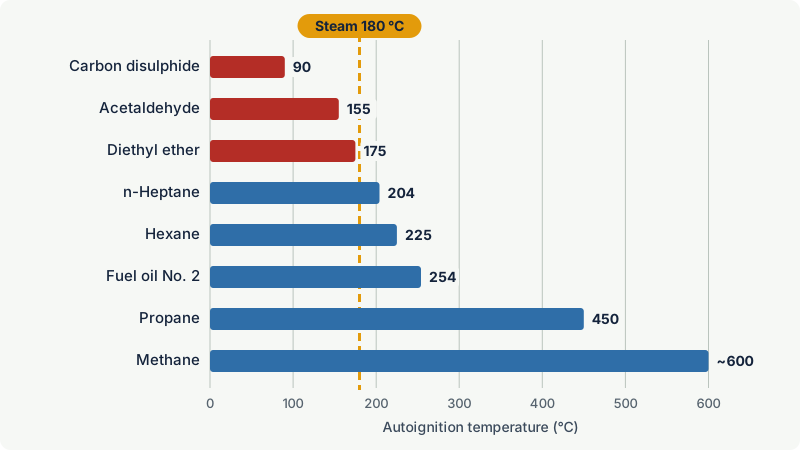
Yes. A flammable gas or vapour mixed with air ignites on its own when it is heated to its autoignition temperature (AIT), and a hot surface can do that heating with no spark or flame at all. A steam line at about 180 °C is hot enough to ignite diethyl ether (AIT 175 °C) or carbon disulphide (AIT 90 °C), but not methane (AIT about 600 °C). Whether a particular surface actually ignites a release depends on its temperature compared with the AIT, its size, the airflow and how long the mixture stays in contact.
Short answer
- The rule: any surface that an explosive atmosphere can reach must stay below the autoignition temperature of the substances present. This is the basis of the temperature classes T1 to T6 for equipment.
- Process surfaces count too: steam and thermal oil lines, heat exchangers, compressor discharge pipes, engine exhausts, dryers and overheating bearings carry no T-class but are ignition sources if hotter than the AIT.
- Low-AIT substances are the danger: carbon disulphide 90 °C, acetaldehyde 155 °C, diethyl ether 175 °C, n-heptane 204 °C (excodex library values).
- Size and conditions matter: the AIT is measured inside a heated vessel; a small hot spot in moving air usually needs a higher temperature, a large hot enclosure can ignite near the AIT.
- Liquids on hot insulation can ignite at lower pipe temperatures than their vapour would on a clean surface (lagging fires).
Why heat alone is enough
Combustion reactions run at every temperature, but at ambient conditions they are far too slow to matter. Heating the mixture speeds them up exponentially; above a certain temperature the reaction releases heat faster than the mixture loses it, and the mixture runs away into a flame. The AIT is the lowest temperature at which this happens in a standard test, in which the substance is introduced into a heated flask (ISO/IEC 80079-20-1, formerly IEC 60079-20-1) and given a fixed time to ignite.
A hot surface works the same way: the gas layer touching it heats up, and if that layer reaches runaway before it is carried away, a flame starts there and travels through the rest of the explosive atmosphere. The US NOAA datasheet for carbon disulphide accordingly warns that its vapour or liquid has ignited on contact with steam pipes, particularly rusted ones, and that the vapour can be ignited by an incandescent light bulb.
How hot is too hot: what decides it
| Factor | Effect |
|---|---|
| Surface temperature vs AIT | Below the AIT, a clean hot surface does not ignite the vapour; above it, ignition becomes possible |
| Size of the hot surface | Small hot spots (a wire, a small component) need a higher temperature than the AIT; large hot surfaces and hot enclosures ignite closer to the AIT |
| Airflow and confinement | Wind or forced draught carries heated gas away quickly; stagnant pockets, enclosures and spaces under lagging favour ignition |
| Contact time | Longer residence of the mixture at the surface favours ignition |
| Liquid on the surface or in insulation | Soaked insulation can self-heat and ignite at lower pipe temperatures; mists and sprays onto hot surfaces are a classic fire cause |
For hydrocarbons released in the open air, API RP 2216 is often quoted (for example by the Australian offshore regulator NOPSEMA) as a rule of thumb that hot-surface ignition should not be assumed unless the surface is about 360 °F above the minimum ignition temperature (the API text gives this as 182 °C; as a temperature difference 360 °F is about 200 K). The same paper notes that the Energy Institute warns this must not be treated as a definite limit. As the title of API RP 2216 says, it concerns the open air, so it says nothing about enclosures, buildings or turbine hoods, and it is not a basis for zoning or equipment selection.
How engineers apply it in hazardous areas
Equipment is selected by temperature class: T1 up to 450 °C, T2 300 °C, T3 200 °C, T4 135 °C, T5 100 °C, T6 85 °C maximum surface temperature, each of which must be below the AIT of the gases present.
Process surfaces are compared with the AIT directly. National guidance adds margins. The German technical rule TRGS 723, for example, asks that in Zone 0 surface temperatures do not exceed 80 % of the ignition temperature even in rare malfunctions, that in Zone 1 they exceed 80 % only rarely (or permanently, up to the ignition temperature, only where the surface temperature is reliably limited), and that in Zone 2 they do not exceed the ignition temperature in normal operation.
Example: A solvent recovery area classified Zone 1 handles diethyl ether (AIT 175 °C) and has a saturated steam line at about 10 bar, so about 180 °C. The pipe is above the AIT itself, not only above the TRGS 723 Zone 1 guide value of 80 % (140 °C). Options are cladding the line so that the outer surface stays below 140 °C, re-routing it out of the zone, or heating with tempered water at a lower temperature. In a toluene area (AIT 530 °C) the same steam line would not be an ignition source by temperature.
Typical controls are well-maintained insulation and cladding (NOPSEMA notes degraded insulation as a common cause of excessive surface temperatures), temperature trips on bearings, compressors and heaters, prompt clean-up of leaks onto lagging, and keeping fired equipment out of hazardous areas.
Common mistakes
- "No spark, no ignition." A hot surface needs no spark; leaks onto exhausts and steam lines cause many fires.
- Checking the motor T-class but not the process line it sits on.
- Using the flash point instead of the AIT. Diesel-type fuels have high flash points but low AITs (fuel oil No. 2: flash point 52 °C, AIT 254 °C).
- Treating a rule of thumb as a design limit. Margins above the AIT are for open-air hydrocarbon releases only, and only as guidance.
Related on excodex
- Ignition sources in hazardous areas: the 13 ignition sources and how to control them
- Hot surfaces in hazardous areas: luminaires, motors, heat tracing and process heat
- Flash point, autoignition temperature and minimum ignition energy: what is the difference?
- Why can a small hot surface exceed the autoignition temperature without igniting gas?
- Gas library: carbon disulphide, diethyl ether
Standards and further reading
- ISO/IEC 80079-20-1, material characteristics for gas and vapour classification, including the autoignition temperature test.
- IEC 60079-0, general requirements for equipment (temperature classes); EN 1127-1:2019, basic concepts and methodology (hot surfaces as an ignition source).
- TRGS 723, German technical rule on avoiding ignition of hazardous explosive atmospheres, section on hot surfaces: bgn-branchenwissen.de
- NOPSEMA information paper, Management of hot surfaces (2021): nopsema.gov.au
- NOAA CAMEO Chemicals datasheet, carbon disulfide: cameochemicals.noaa.gov
- API RP 2216, ignition risk of hydrocarbon liquids and vapours by hot surfaces in the open air.
This article is general technical information prepared by the excodex editorial team. It does not replace the applicable standards, the equipment certificates and instructions, national regulations or the assessment of a competent person.