Is the inside of a silo always classified as Zone 20?
Abstract
Not always. A silo filled often with fine dusty product is usually Zone 20 inside; one filled only briefly and occasionally may be Zone 21. The zone follows how often and how long a dust cloud is present, decided case by case and documented.
Not always, but often. The inside of a silo that is filled frequently with a fine, dusty product is usually Zone 20, because a dust cloud forms in the head space every time it is filled. A silo that is filled only occasionally and briefly may be Zone 21, and a silo holding coarse material with very little fine dust may need a different assessment. The zone follows how often and for how long an explosible cloud is present, and it is decided case by case in the area classification.
Short answer
- The zone definitions are about frequency and duration of a dust cloud: Zone 20 continuously, for long periods or frequently; Zone 21 occasionally in normal operation; Zone 22 not in normal operation and only briefly.
- UK Health and Safety Executive (HSE) guidance HSG103 says the inside of dust-handling equipment will in most plants be Zone 20 or 21.
- An HSE guidance note for the rubber and plastics industries gives a rule of thumb for intermittently filled silos and hoppers: Zone 20 if filling takes more than about 6 hours a day, Zone 21 if less. This is guidance for that sector, not a requirement of the standard.
- The fines content, the filling method (pneumatic or gravity), dust extraction, emptying and inerting all influence the result.
- Whatever the inside is, the surroundings are classified separately: often a small Zone 22 around hatches, the vent filter and connections.
Why the inside of a silo is usually Zone 20
When a silo is filled pneumatically or by free fall, the falling product throws its fine fraction into the free space above the bulk. During filling and for a while afterwards, the head space contains a dust cloud whose concentration varies from point to point, and some part of it is very likely to be within the explosible range. If this happens several times a day, every day, the cloud is present "frequently", which is the Zone 20 definition in Directive 1999/92/EC and IEC 60079-10-2.
The HSE note explains the other side of the argument: a silo might contain an explosible cloud only while it is being filled. If filling is short and infrequent, the cloud is present only occasionally, which points to Zone 21. Dust layers on the silo walls and roof, which can be shaken loose during filling or emptying, must also be considered: Annex I of Directive 1999/92/EC treats layers, deposits and heaps of combustible dust like any other source that can form an explosive atmosphere.
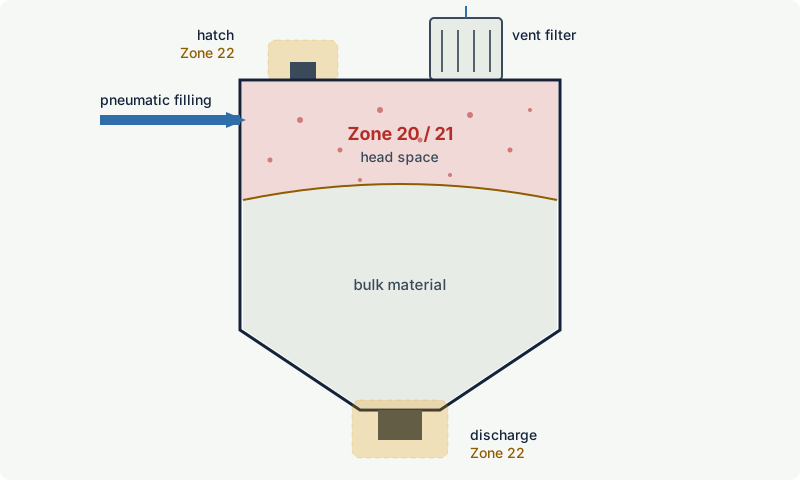
What decides between Zone 20, 21 or something else
| Factor | Points towards a higher zone (20) | Points towards a lower zone (21 or less) |
|---|---|---|
| Filling frequency and duration | Many fillings a day, long filling periods | Short, occasional fillings |
| Fines content | Fine powder (flour, starch, sugar, filter dust) | Pellets or granules with little fine dust, confirmed by sampling |
| Filling method | Pneumatic filling, free fall from height | Gentle gravity filling, dense-phase conveying |
| Dust removal | Head space without extraction | Effective extraction or a vent filter keeping the head space clearer |
| Emptying | Discharge that raises dust inside the silo | Mass flow with little disturbance |
| Inerting | None | Continuously monitored inert atmosphere, which changes the basis of the assessment |
Two of these factors need care. Granular products are not automatically dust free: the HSE note points out that dust-reduced forms such as pellets and granules lower the risk but still leave processes that can generate explosible clouds, because handling breaks particles and fines collect. Inerting prevents an explosive atmosphere only while the oxygen level is controlled; the classification then depends on the reliability of the inerting system and on what happens during maintenance or loss of inert gas, which must be documented.
The decision belongs to the person carrying out the area classification, and in the EU it is recorded in the explosion protection document required by Directive 1999/92/EC. Typical patterns are covered in Dust zones 20, 21 and 22 explained with practical examples.
What the zone means for the equipment
The zone inside the silo sets the equipment protection level for anything installed there: Zone 20 needs EPL Da (ATEX category 1D), Zone 21 needs Db (2D) or better. Level probes, temperature cables and vibrators reaching into the head space are the usual items. HSG103 notes that there is rarely any need to place power-consuming electrical equipment inside a Zone 20, and that portable mains lights should not be lowered into bins.
Classification is only one part of silo safety. Silos are among the places where dust explosions most often start, and they usually also need explosion venting or other protection, isolation from connected elevators and conveyors, and monitoring where the product can self-heat, see Dust collectors, silos and bucket elevators.
Common mistakes
- Classifying a silo as Zone 21 because "it is only filled once a day" without checking how long each filling takes and how fine the product is.
- Assuming pellets or granules produce no dust. Sample the fines that settle inside the silo and in the vent filter.
- Forgetting the vent filter and the outside. The dirty side of the filter and leaks at hatches and connections need their own classification.
- Treating the zone as permanent. A change of product, supplier or filling rate requires a review.
Related on excodex
- Dust zones 20, 21 and 22 explained with practical examples
- Dust collectors, silos and bucket elevators: where dust explosions start
- Is a grain silo or flour mill a dust explosion zone?
- Does a dust layer create a zone, or only a dust cloud?
- Standards space: IEC 60079-10-2
Standards and further reading
- IEC 60079-10-2, classification of areas with explosive dust atmospheres (edition 3.0, 2026).
- Directive 1999/92/EC, Annex I, definitions of Zones 20, 21 and 22: legislation.gov.uk
- HSE, Hazardous area classification for explosible dusts in the rubber and plastics industries (guidance for inspectors): hse.gov.uk
- HSE, HSG103 Safe handling of combustible dusts (2nd edition, 2003): hse.gov.uk (PDF)
- Health and Safety Authority (Ireland), ATEX guide on combustible dust: hsa.ie
This article is general technical information prepared by the excodex editorial team. It does not replace the applicable standards, the equipment certificates and instructions, national regulations or the assessment of a competent person.