Occupational safety International framework and country guides
How and within what time must a workplace accident be reported in Canada?
Part of: Occupational safety and health in Canada: law, authorities and employer duties
Short answer
It depends on the jurisdiction. Federally, deaths, amputations, explosions and similar events go to the Labour Program by phone within 24 hours, with a written report in 14 days. Ontario needs immediate notice and a 48-hour report; Quebec 24 hours to the CNESST.
It depends on who regulates the workplace. A federally regulated employer must report a death, a disabling injury to two or more employees, an amputation, a permanent impairment, an explosion or certain equipment failures to the Labour Program by telephone or fax within 24 hours, and send a written investigation report within 14 days. Provinces set their own lists and deadlines, from "immediately" (Ontario, British Columbia) to 24 hours (Quebec).
Short answer
- Two reports, two bodies. Serious events go to the OSH regulator; injuries needing medical treatment or causing lost time go to the workers' compensation board as a claim report.
- Federal: telephone or fax to the Labour Program as soon as feasible, not later than 24 hours after becoming aware of the result; written Hazardous Occurrence Investigation Report within 14 days for disabling injuries and other listed events; annual report by 1 March.
- Ontario: death or critical injury: inspector, committee and union notified immediately; written report to a Director within 48 hours. Injuries causing disability from usual work or needing medical attention: written notice within 4 days to the committee, representative and union (and to a Director if an inspector requires it).
- Quebec: notice to the CNESST by the fastest means and a written report within 24 hours for a death, loss of a limb, serious injuries to two or more workers or material damage of 150,000 CAD or more.
- British Columbia: WorkSafeBC immediately for serious injury, death, major structural failure, major hazardous release or a fire or explosion with potential for serious injury. Alberta: a Director as soon as possible.
- Do not disturb the scene of a death or serious injury, except to save life, prevent injury or prevent unnecessary damage, until the regulator authorises it (federal Code s. 127; Ontario OHSA s. 51(2)).
The federal procedure step by step
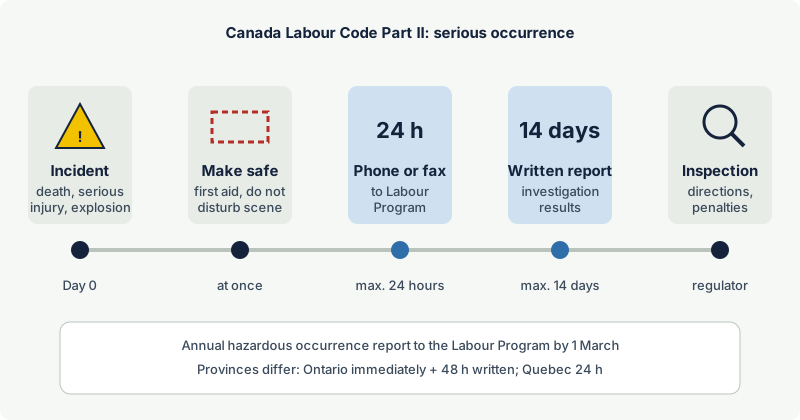
- Employee report. An employee who becomes aware of an accident that caused or is likely to cause injury reports it to the employer without delay (COHSR s. 15.3).
- Investigation. The employer appoints a qualified person to investigate, notifies the work place committee or representative and takes measures to prevent recurrence (s. 15.4).
- 24-hour report. For the results listed in s. 15.5 (death; disabling injury to two or more employees; loss of a body member or its use; permanent impairment of a body function; explosion; boiler or pressure vessel damage with fire or rupture; elevating device damage or free fall), the employer reports date, time, location and nature to the Head of Compliance and Enforcement (Labour Program) by telephone or fax within 24 hours.
- 14-day written report. If the investigation shows a disabling injury, loss of consciousness from electric shock or a toxic or oxygen-deficient atmosphere, the use of rescue or revival procedures, or a fire or explosion, the employer completes the form in Schedule I to Part XV, gives a copy to the committee or representative without delay and sends it to the Labour Program within 14 days (s. 15.8).
- Records. Minor injuries (medical treatment, no disabling injury) are recorded. Boiler, pressure vessel and elevating device events are also recorded in writing within 72 hours. Records and reports are kept for 10 years.
- Annual report of all accidents, illnesses and hazardous occurrences for the calendar year, by 1 March of the following year (s. 15.10).
A "disabling injury" in federal law is one that stops the employee from reporting for work or performing all regular duties on any day after the day of injury, or causes loss of a body part or its use, or permanent impairment of a body function.
Provincial deadlines at a glance
| Jurisdiction | Who to notify | Deadline for serious events |
|---|---|---|
| Federal | Labour Program (ESDC) | 24 hours (phone or fax); written 14 days |
| Ontario | Ministry inspector, committee, union | Immediately; written to a Director within 48 hours |
| Quebec | CNESST | 24 hours |
| British Columbia | WorkSafeBC | Immediately |
| Alberta | Director, Alberta OHS | As soon as possible |
Workers' compensation reports have their own deadlines, for example 3 days for the Workplace Safety and Insurance Board (WSIB) in Ontario and 72 hours for the Workers' Compensation Board in Alberta, according to CCOHS. Check the board's current form and deadline.
Example: On a Friday at 16:00, a worker at a federally regulated rail yard falls from a railcar and fractures a leg. The worker cannot work on Saturday, so it is a disabling injury to one employee. That alone does not trigger the 24-hour telephone report (which needs two or more employees with disabling injuries, or one of the other listed results), but the employer must investigate, send the Schedule I report to the Labour Program within 14 days, include it in the annual report and file the claim with the provincial compensation board. Had the worker lost a finger, the 24-hour telephone report would also apply.
Common mistakes
- Filing only the compensation claim and forgetting the OSH regulator report, or the reverse.
- Cleaning up the scene before the regulator authorises it.
- Counting the 14 days from the end of the investigation: federally they run from the hazardous occurrence.
Related on excodex
- Occupational safety and health in Canada: law, authorities and employer duties
- Incident first response, reporting and scene preservation
- What are the penalties for breaking occupational safety rules in Canada?
- OSH law comparison: appointments and reporting deadlines
Standards and further reading
- Canada Occupational Health and Safety Regulations, SOR/86-304, Part XV (Hazardous Occurrence Investigation, Recording and Reporting): https://laws-lois.justice.gc.ca/eng/regulations/SOR-86-304/
- Canada Labour Code, R.S.C. 1985, c. L-2, ss. 125(1)(c) and 127: https://laws-lois.justice.gc.ca/eng/acts/L-2/
- Ontario Occupational Health and Safety Act, ss. 51 and 52: https://www.ontario.ca/laws/statute/90o01
- CCOHS, Health and Safety Legislation in Canada, Injury Reporting (all jurisdictions): https://www.ccohs.ca/oshanswers/legisl/legislation/injury_reporting.html
This article is general occupational safety and health information prepared by the excodex editorial team. It does not replace the applicable legislation, standards, manufacturers' instructions or the assessment of a competent OSH professional or occupational physician.
More questions on this topic
- What is the main occupational safety and health law in Canada and who enforces it?
- Must an employer in Canada appoint a safety professional or an occupational physician?
- Is a written risk assessment mandatory in Canada, and how often must it be reviewed?
- What OSH training must employers provide to workers in Canada?
- Are pre-employment and periodic medical examinations required for workers in Canada?
- What are the penalties for breaking occupational safety rules in Canada?
- Is a safety committee or a worker safety representative required in Canada?
- How are explosive atmospheres and Ex equipment regulated in Canada?
Part of: Occupational safety and health in Canada: law, authorities and employer duties