Occupational safety International framework and country guides
How are explosive atmospheres and Ex equipment regulated in Canada?
Part of: Occupational safety and health in Canada: law, authorities and employer duties
Short answer
Canada does not use ATEX. Hazardous locations are classified and wired under Section 18 of the Canadian Electrical Code (Zones 0-2, 20-22), and equipment must be certified by an SCC-accredited body to CSA standards. OSH law adds LEL limits and, in Alberta, engineer-led zoning.
Canada does not apply the EU ATEX directives. Hazardous locations are classified and their electrical installations designed under Section 18 of the Canadian Electrical Code (CEC), Part I, which uses Zones 0, 1 and 2 for gases and 20, 21 and 22 for dusts, and equipment must be certified by a certification body accredited by the Standards Council of Canada (SCC). Occupational safety and health (OSH) law adds limits on flammable concentrations and, in some provinces, rules on who classifies the area.
Short answer
- Installation code: CEC Part I (CSA C22.1), Section 18, adopted with local amendments by each province and territory and enforced by provincial electrical safety authorities.
- Classification: Zones 0, 1, 2 (gases and vapours) and 20, 21, 22 (dusts) for new work; the older Class and Division system remains in an annex for existing facilities.
- Equipment: must be approved, normally certified by an SCC-accredited body (or field-approved) to CSA C22.2 standards (many are national versions of IEC 60079), and marked for the zone, group and temperature class.
- ATEX and IECEx: neither CE/ATEX marking nor an IECEx certificate is a Canadian approval; ask an SCC-accredited certification body whether existing IECEx test reports can support Canadian certification.
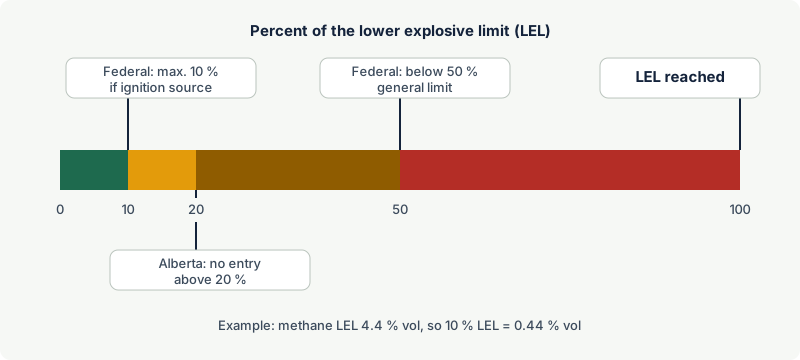
- Federal OSH limits: airborne flammable concentrations below 50% of the lower explosive limit (LEL), and not above 10% LEL where an ignition source could ignite them (COHSR s. 10.20).
- Alberta: no entry above 20% LEL except for equipped emergency responders; hazardous locations classified under CEC Section 18 by a professional engineer or a competent person authorised by one, with documented boundaries.
The electrical route: CEC Section 18 and certification
In Canada the main explosion-protection rules sit in the electrical code rather than in an OSH directive. The CEC is published by CSA as C22.1 and becomes law when a province or territory adopts it. Section 18 sets the classification of hazardous locations, the wiring methods and the protection methods permitted in each zone.
Federal OSH regulations make the CEC part of OSH law for federally regulated employers: electrical equipment must meet the standards of the Canadian Electrical Code, Part I in its design, construction and installation where feasible, and in its operation and maintenance (COHSR s. 8.3). Note that the COHSR definition still cites the 1990 edition of C22.1, while provinces adopt current editions; check which edition applies with the authority having jurisdiction.
For equipment, provincial electrical regulations require products to be approved. In British Columbia, for example, electrical equipment must bear the mark or label of a certification agency accredited by the SCC, or an approval label issued by Technical Safety BC or another accredited organisation, such as a field approval (Electrical Safety Regulation s. 21(1)). Technical Safety BC publishes examples of the marks and labels it accepts. CE and ATEX marking or an IECEx certificate alone is not such a mark, so the product is not approved.
What OSH law adds
| Rule | Federal (COHSR) | Alberta (OHS Code) |
|---|---|---|
| Flammable concentration in the work place | Below 50% LEL; not above 10% LEL where an ignition source may ignite it (s. 10.20) | No one may enter or work where more than 20% LEL is present, except competent, equipped emergency responders (s. 162) |
| Area classification | Through the CEC | Hazardous locations classified under CEC Section 18 (or Alberta's code for electrical installations at oil and gas facilities, where it applies) by a professional engineer or a competent person authorised by one; documentation of boundaries and ignition-prevention measures; reviewed when the basis changes (s. 162.1) |
| Ignition control | Static electricity controlled using NFPA 77 where ignitable mixtures may form (s. 10.12) | Equipment must not ignite the flammable substance; static controlled by bonding and grounding (s. 165) |
| Hot work | Not in a hazardous confined space above 10% LEL or 23% oxygen, unless a qualified person has found it safe (s. 11.1) | Permit, and testing showing no more than 20% LEL, before hot work in a hazardous location or where an explosive atmosphere may exist (s. 169) |
Example: An EU manufacturer wants to supply ATEX-certified gas detectors and junction boxes to an Alberta gas plant. The plant's area classification drawing, signed under OHS Code s. 162.1, shows Zone 1, group IIA, T3. The products need Canadian certification by an SCC-accredited body to the CSA C22.2 No. 60079 series, with Canadian marking such as Ex db IIB T4 Gb, before the electrical inspector will accept them. The manufacturer asks an SCC-accredited certification body which of its existing IECEx test reports it can use and which Canadian requirements need additional assessment or tests. The plant then checks that the marking matches the zone, gas group and temperature class.
Practical points
- Ask early which edition of the CEC the province has adopted and whether it has amendments.
- Keep classification drawings and the basis of classification up to date; Alberta requires review when the basis changes.
- Check the certification mark and the Canadian indicator on every nameplate, not just the Ex string.
- Remember that mechanical equipment, PPE in hazardous areas and work procedures (hot work, gas testing) are covered by OSH regulations and good practice rather than an ATEX-type equipment directive.
Related on excodex
- Occupational safety and health in Canada: law, authorities and employer duties
- North American hazardous location approvals: NEC 500/505/506, UL, CSA and FM
- Zones vs Divisions: IEC and ATEX zones compared with NEC Class I Division 1 and 2
- ATEX vs IECEx: differences, similarities and which one you need
- Gas library: methane
Standards and further reading
- Canada Occupational Health and Safety Regulations, SOR/86-304, ss. 8.1, 8.3, 10.12, 10.20 and 11.1: https://laws-lois.justice.gc.ca/eng/regulations/SOR-86-304/
- Alberta OHS Code, Alta. Reg. 191/2021, Part 10 (ss. 161.1 to 169): https://kings-printer.alberta.ca/documents/Regs/2021_191.pdf
- Technical Safety BC, approved certification marks for electrical products: https://www.technicalsafetybc.ca/regulatory-resources/regulatory-notices/approved-certification-marks-electrical-products
- CSA C22.1, Canadian Electrical Code, Part I, Section 18 (hazardous locations); CSA C22.2 No. 60079 series (equipment for explosive atmospheres, national adoptions of IEC 60079); IEC 60079-14 (electrical installations design, selection and erection).
This article is general occupational safety and health information prepared by the excodex editorial team. It does not replace the applicable legislation, standards, manufacturers' instructions or the assessment of a competent OSH professional or occupational physician.
More questions on this topic
- What is the main occupational safety and health law in Canada and who enforces it?
- Must an employer in Canada appoint a safety professional or an occupational physician?
- Is a written risk assessment mandatory in Canada, and how often must it be reviewed?
- How and within what time must a workplace accident be reported in Canada?
- What OSH training must employers provide to workers in Canada?
- Are pre-employment and periodic medical examinations required for workers in Canada?
- What are the penalties for breaking occupational safety rules in Canada?
- Is a safety committee or a worker safety representative required in Canada?
Part of: Occupational safety and health in Canada: law, authorities and employer duties