Occupational safety International framework and country guides
Occupational safety and health in Canada: law, authorities and employer duties
Abstract
Canada has 14 OSH regimes: the Canada Labour Code Part II for federally regulated employers (about 6% of workers) and a separate act and regulator in each province and territory. Employers carry a general duty of care, must report serious incidents fast and work with joint committees.
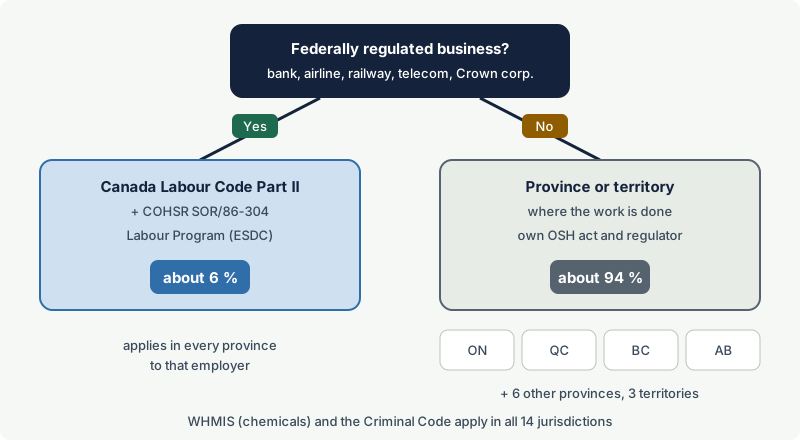
Canada has no single national occupational safety and health (OSH) law. Federally regulated employers, such as banks, airlines, railways, interprovincial transport, telecommunications and federal Crown corporations, follow Part II of the Canada Labour Code, enforced by the Labour Program of Employment and Social Development Canada (ESDC); every other workplace follows the OSH act of the province or territory where the work is done. All 14 regimes share the same core: a general duty of care on the employer, three worker rights (to know, to participate and to refuse dangerous work), joint committees or representatives, fast reporting of serious incidents and fines in the hundreds of thousands to millions of Canadian dollars.
This guide explains the federal regime in detail and shows how the largest provinces (Ontario, Quebec, British Columbia and Alberta) differ, so that an employer, contractor or engineer starting work in Canada knows which rules apply and what to do first.
Key points
- Canada has 14 OSH jurisdictions: one federal, ten provincial and three territorial. According to the Canadian Centre for Occupational Health and Safety (CCOHS), about 6% of workers fall under federal law and about 94% under the law of their province or territory.
- The federal law is the Canada Labour Code, Part II (Code canadien du travail, partie II) and the Canada Occupational Health and Safety Regulations, SOR/86-304 (COHSR). Section 124 says every employer shall ensure that the health and safety at work of every person it employs is protected.
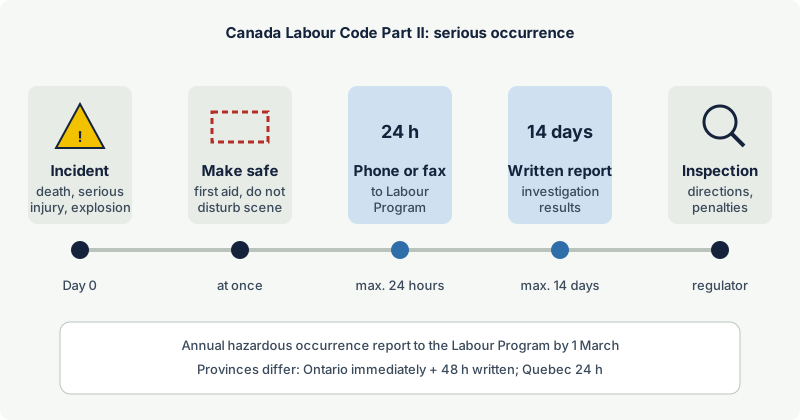
- Under federal law, a death, a disabling injury to two or more employees, the loss of a body part or of its use, a permanent impairment, an explosion and some boiler, pressure vessel or lift failures must be reported to the Labour Program by telephone or fax within 24 hours; a written investigation report follows within 14 days and an annual report by 1 March.
- A work place health and safety committee is required at federal work places with 20 or more employees, a policy committee for employers with 300 or more, and a representative below 20. Most provinces also use 20 workers as the committee threshold (Saskatchewan uses 10).
- Canadian OSH law generally does not require employers to appoint a safety professional or an occupational physician. Duties are placed on the employer, supervisors and "qualified" or "competent" persons.
- Chemicals follow WHMIS (Workplace Hazardous Materials Information System), the Canadian implementation of the UN GHS; the Hazardous Products Regulations now refer to the seventh revised edition of the GHS.
- Since the 2003 amendments (S.C. 2003, c. 21), the Criminal Code (s. 217.1) imposes a legal duty on anyone who directs work to take reasonable steps to prevent bodily harm, so a fatal accident can lead to criminal charges against organisations and individuals.
Who regulates which workplace
The first question for any employer is which of the 14 regimes applies. The answer depends on the type of business, not on the location of the head office. A bank branch in Toronto follows federal law; a factory next door follows Ontario law. A company with warehouses in three provinces must follow three provincial laws, one for each site.
| Jurisdiction | Main OSH law (official name) | Regulator for prevention and enforcement | Workers' compensation |
|---|---|---|---|
| Federal | Canada Labour Code, Part II (Code canadien du travail, partie II); Canada Occupational Health and Safety Regulations, SOR/86-304 (Règlement canadien sur la santé et la sécurité au travail) | Labour Program, ESDC (Head of Compliance and Enforcement) | Board of the province where the employee works; federal public servants are covered by the Government Employees Compensation Act at the rates and conditions of that province |
| Ontario | Occupational Health and Safety Act, R.S.O. 1990, c. O.1 (Loi sur la santé et la sécurité au travail) and its regulations | Ministry of Labour, Immigration, Training and Skills Development | Workplace Safety and Insurance Board (WSIB) |
| Quebec | Loi sur la santé et la sécurité du travail, RLRQ c. S-2.1 (Act respecting occupational health and safety) | CNESST, Commission des normes, de l'équité, de la santé et de la sécurité du travail | CNESST (single body) |
| British Columbia | Workers Compensation Act, Part 2, and the Occupational Health and Safety Regulation | WorkSafeBC | WorkSafeBC (single body) |
| Alberta | Occupational Health and Safety Act, S.A. 2020, c. O-2.2, and the OHS Code, Alta. Reg. 191/2021 | Alberta OHS (provincial government) | Workers' Compensation Board, Alberta |
Provincial and territorial laws are similar in structure but differ in detail, so always read the text of the jurisdiction that applies; mining, nuclear facilities and some energy activities have additional sector rules.
Employer and worker duties
The general duty and the hierarchy of controls
Canadian OSH law is built on the "internal responsibility system": employers, supervisors and workers share responsibility, and the regulator checks that the system works. In federal law, section 124 of the Code sets the general duty and section 125 lists more than 40 specific duties, including:
- investigating, recording and reporting accidents, occupational illnesses and other hazardous occurrences;
- providing the information, instruction, training and supervision each employee needs;
- making every employee aware of every known or foreseeable hazard in the area where they work;
- developing, with the committee or representative, a programme for the prevention of hazards;
- responding in writing to committee recommendations within 30 days;
- ensuring that committee members and representatives receive the prescribed training.
Section 122.2 sets the order of preventive measures: eliminate the hazard first, then reduce it, and only then provide personal protective equipment (PPE). Ontario's act, in section 25, adds a duty to take every precaution reasonable in the circumstances and, at workplaces with more than five workers, to prepare and review at least annually a written OSH policy and a programme to implement it.
Worker duties and the three rights
Workers must use the protective equipment provided, follow procedures, report hazards and every injury, and cooperate with committees (federal s. 126). In return, every Canadian jurisdiction recognises three rights: the right to know about hazards, the right to participate (committees and representatives) and the right to refuse work they have reasonable cause to believe is dangerous (federal s. 128). The refusal is not allowed where it would put another person directly in danger or where the danger is a normal condition of the job.
Criminal liability
After the 1992 Westray coal mine explosion in Nova Scotia, in which 26 miners died, Parliament added section 217.1 to the Criminal Code (S.C. 2003, c. 21, often called the Westray Bill, in force since 31 March 2004). Anyone who undertakes, or has the authority, to direct how another person works has a legal duty to take reasonable steps to prevent bodily harm to that person or others. Sections 22.1 (offences of negligence, such as criminal negligence causing death) and 22.2 (other offences) set the rules for holding an organisation responsible through its representatives and senior officers. Such cases are investigated by the police and prosecuted by Crown prosecutors, separately from OSH regulators.
OSH services, risk assessment and training
No mandatory safety professional or occupational physician
Unlike Türkiye or many EU states, Canadian law does not make the employer appoint an OSH specialist or an occupational physician based on headcount. The federal regulations instead require a "qualified person" (someone who, because of knowledge, training and experience, can perform a specified duty safely and properly) for tasks such as investigating hazardous occurrences or assessing hazardous substances. First aid is regulated in detail: under COHSR Part XVI, a federal work place with six or more employees working at any time needs a trained first aid attendant, and a remote work place (ambulance response time over two hours) needs one from two employees. Many medium and large employers employ safety professionals voluntarily, but no headcount rule obliges them to.
Hazard identification and prevention programmes
The federal regime does not use the term "risk assessment", but COHSR Part XIX requires a hazard prevention programme, developed with the policy committee, work place committee or representative. It must include an implementation plan, a hazard identification and assessment methodology, a record of the hazards, preventive measures in the order elimination, reduction, PPE and administrative controls, employee training and a programme evaluation. The evaluation must be repeated at least every three years and whenever conditions or hazard information change, and each evaluation report is kept for six years.
Provinces take different routes. Alberta's OHS Code, Part 2, requires a hazard assessment before work begins, a written report with the date, and a repeat at reasonably practicable intervals and whenever a new process is introduced or an operation changes; affected workers must be involved. In Quebec, the Regulation respecting prevention and participation mechanisms in an establishment (Règlement sur les mécanismes de prévention et de participation en établissement), in force since 1 October 2025, sets the deadlines for drawing up, implementing and updating a prevention programme (programme de prévention) or, depending on the size of the establishment, an action plan (plan d'action), and the hierarchy of prevention measures to follow. Ontario relies on the written policy and programme, plus specific assessments, for example of the risks of workplace violence and a written assessment of exposure to designated substances.
Training
Federal employers must train each employee on the hazard prevention programme, the hazards of their work place and their reporting duties, shortly before a new activity or hazard and whenever new hazard information appears, and must review the training programme at least every three years (COHSR s. 19.6). Each training session is acknowledged in writing by both sides. Ontario requires every worker to complete basic OSH awareness training as soon as practicable and every supervisor within one week of starting as a supervisor (O. Reg. 297/13); construction workers using fall protection need approved working at heights training, valid for three years. WHMIS training is required in every jurisdiction for workers who may be exposed to hazardous products.
Medical surveillance
There is no general duty to give pre-employment or periodic medical examinations. Examinations are required for specific exposures and jobs. In federal law, if the qualified person's report on a hazardous substance recommends medical examinations, the employer must consult a physician, and if the physician confirms the need, the employee may not handle the substance until a physician acceptable to the employee has declared them fit, or fit with restrictions, at the employer's cost (COHSR s. 10.7). Ontario's Designated Substances regulation (O. Reg. 490/09) requires pre-placement, periodic, acute exposure and exit examinations for asbestos, benzene, coke oven emissions, isocyanates, lead, mercury and silica where an assessment shows that workers' health may be affected. Human rights law limits medical requirements to those that are bona fide occupational requirements.
Reporting accidents and occupational illness
Two separate reports usually follow a workplace injury in Canada: one to the OSH regulator for serious events, and one to the workers' compensation board for any injury that needs medical treatment or causes lost time.
| Jurisdiction | Events to report at once | Deadline | Follow-up |
|---|---|---|---|
| Federal | Death; disabling injury to two or more employees; loss of a body part or its use; permanent impairment of a body function; explosion; boiler or pressure vessel fire or rupture; elevating device damage or free fall | As soon as feasible, not later than 24 hours, by telephone or fax to the Labour Program | Written investigation report within 14 days for disabling injuries, loss of consciousness from shock or toxic or oxygen-deficient atmosphere, rescue or revival, fire or explosion; annual report by 1 March |
| Ontario | Death or critical injury (defined in O. Reg. 420/21) | Inspector, committee and union notified immediately; written report to a Director within 48 hours | Written notice within 4 days for other injuries needing medical attention or causing disability; WSIB report within 3 days |
| Quebec | Death; loss of all or part of a limb or of its use, or significant physical trauma; injuries to two or more workers serious enough to keep them off work for a working day; material damage of 150,000 CAD or more (Act s. 62) | Written report to the CNESST within 24 hours; committee and representative informed | Entry in the register of accidents, incidents and first aid |
| British Columbia | Serious injury or death; major structural failure or collapse (building, bridge, tower, crane, hoist, temporary support, excavation); major release of a hazardous substance; fire or explosion with potential for serious injury; incidents named in the regulation | Immediately, to WorkSafeBC | Employer investigation; claim reporting to WorkSafeBC |
| Alberta | Death; injury where the worker has been or will be admitted to hospital beyond emergency or urgent care; unplanned or uncontrolled explosion, fire or flood causing or able to cause serious injury; collapse or upset of a crane, derrick or hoist; structural failure (Act s. 33) | As soon as possible, to a Director | Workers' compensation report within 72 hours |
The scene of a death or serious injury must not be disturbed except to save life, prevent further injury, maintain an essential public service or prevent unnecessary damage (federal s. 127). Federal records of hazardous occurrence investigations, minor injuries and annual reports are kept for 10 years.
Example: A forklift overturns in a federally regulated grain terminal and the driver loses a hand. The employer gives first aid, calls emergency services and keeps the area closed. Within 24 hours it phones the Labour Program with the date, time, place and nature of the occurrence, appoints a qualified person to investigate and informs the work place committee. Within 14 days it sends the written Hazardous Occurrence Investigation Report (Schedule I to Part XV) with direct causes and corrective measures, and it includes the event in the annual report due by 1 March of the following year. A separate claim goes to the workers' compensation board of the province.
Committees, representatives and worker participation
| Jurisdiction | Joint committee | Representative |
|---|---|---|
| Federal | Work place committee at each work place with 20 or more employees; policy committee for employers with 300 or more employees | Health and safety representative for work places with fewer than 20 employees |
| Ontario | 20 or more workers regularly employed, or where a designated substance regulation applies, or by Minister's order | More than 5 workers (where no committee is required) |
| Quebec | Establishments with 20 or more workers; implementing regulation in force since 1 October 2025 | Representative at 20 or more; liaison officer (agent de liaison) at 19 or fewer |
| Alberta | 20 or more workers regularly employed, or by a Director | 5 to 19 workers |
| British Columbia | 20 or more workers, or by order | More than 9 and fewer than 20 workers |
At least half of the members of a federal committee must be employees without managerial functions, chosen by the employees or their union. Federal work place committees meet at least nine times a year, and the employer must ensure that the committee or representative inspects all or part of the work place each month, so that every part is inspected at least once a year. In Ontario, at least one worker member and one management member must be certified members, who complete training set by the Chief Prevention Officer; this does not apply to construction projects with fewer than 50 workers or expected to last less than three months.
Inspections, enforcement and penalties
Labour Program officials exercise the powers of the Head of Compliance and Enforcement. They may enter work places, issue a direction to stop a contravention, and, where there is a danger, order that a machine, place or activity is not used until it is corrected (s. 145). Provincial inspectors have similar powers to issue orders and stop work.
| Regime | Maximum penalty in the current consolidated text |
|---|---|
| Canada Labour Code Part II (s. 148) | Indictment: 1,000,000 CAD and/or 2 years' imprisonment; summary conviction: 100,000 CAD, or 1,000,000 CAD where the offence directly caused death or serious injury or illness |
| Federal administrative monetary penalties (Part IV) | Up to 250,000 CAD per violation, set by regulation |
| Ontario OHSA (s. 66) | Individuals: 500,000 CAD and/or 12 months; corporations: 2,000,000 CAD (since 19 December 2024), with a minimum of 500,000 CAD for a second or later offence causing death or serious injury within two years; directors and officers failing their s. 32 duties: 1,500,000 CAD and/or 12 months |
| Alberta OHS Act (s. 48) | First offence: 500,000 CAD (plus up to 30,000 CAD a day for a continuing offence) and/or 6 months; second or later: 1,000,000 CAD (plus up to 60,000 CAD a day) and/or 12 months |
Due diligence is a defence in most Canadian OSH prosecutions: the accused must prove that it exercised due care and diligence to avoid the contravention (federal s. 148(4), which excludes the duties to report occurrences and to answer committee recommendations; Ontario s. 66(3) speaks of "every precaution reasonable in the circumstances"). Written programmes, training records, inspection records and follow-up of committee recommendations are therefore the employer's evidence. Courts can also impose criminal sentences under the Criminal Code where s. 217.1 applies.
Chemicals, explosive atmospheres, major hazards and PPE
WHMIS and exposure limits
WHMIS is a combination of federal law for suppliers (the Hazardous Products Act and the Hazardous Products Regulations, SOR/2015-17) and OSH law in each jurisdiction for workplaces (labels, safety data sheets and worker education). The 2022 amendments (SOR/2022-272) aligned the regulations with the seventh revised edition of the GHS, and the transition period has ended. Federal employers must keep chemical exposure below the threshold limit values of the American Conference of Governmental Industrial Hygienists (ACGIH), as amended from time to time (COHSR s. 10.19); provinces publish their own limit tables. Amendments to the COHSR made by SOR/2026-10 (registered on 30 January 2026, in force one year after registration) add procedures against heat and cold stress based on the ACGIH screening criteria, controls for engineered nanomaterials, a radon limit of 200 Bq/m3 (now 800) and 30-year retention of hazardous substance and air sampling records (now three years for sampling records). See GHS at UN level.
Explosive atmospheres and Ex equipment
Canada does not use ATEX. Electrical installations follow the Canadian Electrical Code (CEC), Part I, published as CSA C22.1 and adopted with amendments by each province and territory. Section 18 classifies hazardous locations in Zones 0, 1 and 2 (gases and vapours) and 20, 21 and 22 (dusts); the older Class and Division system is kept in an annex for existing installations. Electrical equipment must be approved, in practice certified by a certification body accredited by the Standards Council of Canada (SCC) to the CSA C22.2 standards (or field-approved by an accredited inspection body or the provincial regulator), many of which are national adoptions of IEC 60079 parts. An ATEX or IECEx certificate is not by itself a Canadian approval.
OSH law adds workplace limits. Federally, airborne flammable concentrations must stay below 50% of the lower explosive limit (LEL), and not above 10% where an ignition source could ignite them (COHSR s. 10.20). Alberta prohibits entry into an area above 20% of the LEL, except for equipped emergency responders, and requires hazardous locations to be classified under CEC Section 18 by a professional engineer, or a competent person authorised by one, with documented boundaries (OHS Code ss. 162 and 162.1). See the ATEX-book guide on North American hazardous location approvals.
Major-hazard sites
Canada has no single Seveso-type OSH law. The main national rule is the Environmental Emergency Regulations, 2019 (SOR/2019-51) under the Canadian Environmental Protection Act, 1999, administered by Environment and Climate Change Canada. A facility holding a listed substance at or above its threshold (for example 4.5 tonnes of propane, 1.13 tonnes of chlorine or 4.5 tonnes of anhydrous ammonia) must notify within 90 days, and where the plan criteria are met (in short, when the quantity and the largest container system reach the threshold) prepare an environmental emergency plan, bring it into effect within 12 months, exercise it every year and run a full-scale exercise every five years. Process safety management itself is covered by general OSH law, by sector regulators (for example for pipelines and energy facilities) and by the voluntary standard CSA Z767; there is no federal equivalent of the US OSHA Process Safety Management standard.
PPE
There is no CE-type conformity mark for PPE in Canada. OSH regulations require PPE that meets named standards, for example CSA Z94.1 (or ANSI Z89.1) for industrial headwear, CSA Z195 for protective footwear, CSA Z94.3 for eye and face protection, CSA Z94.4 for respirator selection and use and the CSA Z259 series for fall protection (COHSR Part XII). Products are usually marked or certified to these standards; check the label and the certificate before purchase.
Canada compared with the EU framework and Türkiye
| Topic | Canada (federal example) | EU framework (Directive 89/391/EEC) | Türkiye (Law No. 6331) |
|---|---|---|---|
| Structure | 14 separate regimes | One directive, national laws in each member state | One national law |
| Safety professional and physician | Not required by headcount; "qualified persons" for specific tasks | Employer designates competent workers or external services | OSH specialist and workplace physician (in-house or from an external OSH unit) for every employer; limited self-provision by a trained employer (Law 6331 Art. 6) |
| Risk assessment | Hazard prevention programme, evaluated at least every 3 years | Written assessment required, kept up to date | Renewed at least every 2, 4 or 6 years for very hazardous, hazardous and less hazardous workplaces, and at once after changes |
| Serious incident report | 24 hours to the Labour Program; written in 14 days | Set by national law | Work accident to SGK within 3 working days |
| Committee | 20 or more employees (policy committee 300 or more) | Consultation and worker representatives; committees by national law | OSH committee at 50 or more workers with permanent work over 6 months |
| Chemicals | WHMIS (GHS rev. 7) | CLP Regulation | CLP-aligned SEA Regulation |
| Ex equipment | CEC Section 18, SCC-accredited certification | ATEX Directive 2014/34/EU | ATEX via Turkish regulations |
The practical lesson for employers arriving from the EU or Türkiye: in Canada nobody is appointed "on behalf of" the employer to carry legal OSH duties. The employer and every supervisor carry them personally, and due diligence must be proven with records.
Common mistakes
- Applying the law of the head office province to all sites. Each site follows the law of the province where the work is done, unless the business is federally regulated.
- Reporting only to the workers' compensation board. A claim to the WSIB, CNESST or WorkSafeBC does not replace the immediate report of a serious event to the OSH regulator.
- Accepting ATEX or IECEx certificates for equipment in a Canadian hazardous location. Equipment needs certification by an SCC-accredited body and Canadian marking.
- Assuming no committee is needed because there is a safety manager. Committees and representatives are mandatory by headcount and cannot be replaced by a staff function.
- Treating training as a one-off induction. Federal law requires training before new tasks and a programme review at least every three years; Ontario requires an annual review of training for workers exposed to hazardous materials or physical agents.
Frequently asked questions
Is there a national OSH regulator in Canada?
No. The Labour Program of ESDC regulates only federally regulated employers. Each province and territory has its own regulator, such as the Ontario Ministry of Labour, Immigration, Training and Skills Development, the CNESST in Quebec and WorkSafeBC. CCOHS is a national public institute that provides information but does not enforce the law.
Does Canada follow OSHA standards?
No. United States OSHA standards have no legal force in Canada. Some Canadian regulations reference American documents, such as the ACGIH threshold limit values in federal law or ANSI Z89.1 as an alternative for head protection, but only because Canadian law incorporates them.
Is a written OSH policy required in Canada?
Yes, in most cases. Federal employers must make a statement of their general health and safety policy available to employees (Canada Labour Code s. 125(1)(d)). Ontario employers with more than five workers must prepare a written policy and review it at least annually, and Alberta employers with 20 or more workers must establish a health and safety programme.
Can a worker in Canada refuse dangerous work?
Yes, in every jurisdiction. Under federal law the worker reports the refusal to the employer, who investigates in the worker's presence; if it is not resolved, two committee members (one worker and one employer member) or the representative investigate and report, the employer decides, and if the worker still refuses, the Labour Program is informed and normally investigates and decides (ss. 128 and 129). The refusal is not protected where it puts another person directly in danger or the danger is a normal condition of the job.
What happens if a worker dies at work in Canada?
The employer secures the scene, calls emergency services and notifies the OSH regulator within the jurisdiction's deadline (no later than 24 hours federally, immediately in Ontario and British Columbia). The regulator investigates and may prosecute under OSH law; the police may investigate under the Criminal Code.
Related on excodex
- What is the main OSH law in Canada and who enforces it?
- How and within what time must a workplace accident be reported in Canada?
- Is a safety committee or a worker safety representative required in Canada?
- How are explosive atmospheres and Ex equipment regulated in Canada?
- Occupational safety and health in the United States
- OSH law comparison: appointments and reporting deadlines
Standards and further reading
- Canada Labour Code, R.S.C. 1985, c. L-2, Part II (Occupational Health and Safety) and Part IV (Administrative Monetary Penalties), consolidated text current to 19 October 2026: https://laws-lois.justice.gc.ca/eng/acts/L-2/
- Canada Occupational Health and Safety Regulations, SOR/86-304 (Parts X, XII, XV, XVI, XIX), consolidated text current to 19 October 2026: https://laws-lois.justice.gc.ca/eng/regulations/SOR-86-304/
- Regulations Amending Certain Regulations Made Under the Canada Labour Code, SOR/2026-10, Canada Gazette Part II, 11 February 2026: https://gazette.gc.ca/rp-pr/p2/2026/2026-02-11/html/sor-dors10-eng.html
- Government Employees Compensation Act, R.S.C. 1985, c. G-5: https://laws-lois.justice.gc.ca/eng/acts/G-5/
- Criminal Code, R.S.C. 1985, c. C-46, ss. 22.1, 22.2 and 217.1: https://laws-lois.justice.gc.ca/eng/acts/C-46/section-217.1.html ; CCOHS, Westray Bill (Bill C-45) overview: https://www.ccohs.ca/oshanswers/legisl/billc45.html
- Environmental Emergency Regulations, 2019, SOR/2019-51: https://laws-lois.justice.gc.ca/eng/regulations/SOR-2019-51/
- Hazardous Products Regulations, SOR/2015-17, as amended by SOR/2022-272: https://laws-lois.justice.gc.ca/eng/regulations/SOR-2015-17/
- Canadian Human Rights Act, s. 15 (bona fide occupational requirements): https://laws-lois.justice.gc.ca/eng/acts/H-6/section-15.html
- Ontario Occupational Health and Safety Act, R.S.O. 1990, c. O.1 (consolidation from 27 November 2025): https://www.ontario.ca/laws/statute/90o01 ; O. Reg. 420/21 (notices and reports): https://www.ontario.ca/laws/regulation/210420 ; O. Reg. 297/13 (awareness and training): https://www.ontario.ca/laws/regulation/130297 ; O. Reg. 490/09 (designated substances): https://www.ontario.ca/laws/regulation/090490
- Alberta Occupational Health and Safety Act, S.A. 2020, c. O-2.2 (current as of 11 June 2025) and OHS Code, Alta. Reg. 191/2021 (current as of 31 March 2025): https://kings-printer.alberta.ca/documents/Acts/O02P2.pdf and https://kings-printer.alberta.ca/documents/Regs/2021_191.pdf
- CNESST news releases (Government of Quebec) on the prevention and participation mechanisms: interim regime and thresholds (15 October 2024) https://www.quebec.ca/nouvelles/actualites/details/loi-modernisant-le-regime-de-sante-et-de-securite-du-travail-appliquer-le-regime-interimaire-des-maintenant-un-avantage-pour-tous-les-milieux-de-travail-58834 ; regulation in force (1 October 2025) https://www.quebec.ca/nouvelles/actualites/details/loi-modernisant-le-regime-de-sante-et-de-securite-du-travail-un-nouveau-reglement-favorisant-la-prevention-des-le-1er-octobre-2025-66137
- WorkSafeBC, Joint health and safety committees: https://www.worksafebc.com/en/health-safety/create-manage/joint-health-safety-committees
- CCOHS, Health and Safety Legislation in Canada (introduction and injury reporting) and Health and Safety Committees: https://www.ccohs.ca/oshanswers/legisl/legislation/intro.html , https://www.ccohs.ca/oshanswers/legisl/legislation/injury_reporting.html , https://www.ccohs.ca/oshanswers/hsprograms/hscommittees/whatisa.html
- Health Canada, WHMIS: https://www.canada.ca/en/health-canada/services/environmental-workplace-health/occupational-health-safety/workplace-hazardous-materials-information-system.html
- Türkiye: Occupational Health and Safety Law No. 6331 (İş Sağlığı ve Güvenliği Kanunu), 20 June 2012, Arts. 6, 14 and 22: https://www.mevzuat.gov.tr/mevzuat?MevzuatNo=6331&MevzuatTur=1&MevzuatTertip=5 ; risk assessment renewal intervals as summarised by the Ministry of Labour and Social Security in its manual handling application guide (revision 2025): https://www.csgb.gov.tr/Media/hsdfu2fk/elle-taşıma-işleri-yönetmeliği-uygulama-rehberi-18-03-2025.pdf
- CSA C22.1, Canadian Electrical Code, Part I (installation rules, Section 18 hazardous locations); CSA C22.2 No. 60079 series (equipment for explosive atmospheres); CSA Z94.1, Z94.3, Z94.4, Z195 and Z259 (PPE); CSA Z767 (process safety management).
This article is general occupational safety and health information prepared by the excodex editorial team. It does not replace the applicable legislation, standards, manufacturers' instructions or the assessment of a competent OSH professional or occupational physician.
Questions on this topic
- What is the main occupational safety and health law in Canada and who enforces it?
- Must an employer in Canada appoint a safety professional or an occupational physician?
- Is a written risk assessment mandatory in Canada, and how often must it be reviewed?
- How and within what time must a workplace accident be reported in Canada?
- What OSH training must employers provide to workers in Canada?
- Are pre-employment and periodic medical examinations required for workers in Canada?
- What are the penalties for breaking occupational safety rules in Canada?
- Is a safety committee or a worker safety representative required in Canada?
- How are explosive atmospheres and Ex equipment regulated in Canada?
- Which rules apply to major-hazard chemical sites in Canada?