Occupational safety International framework and country guides
Is a safety committee or a worker safety representative required in Canada?
Part of: Occupational safety and health in Canada: law, authorities and employer duties
Short answer
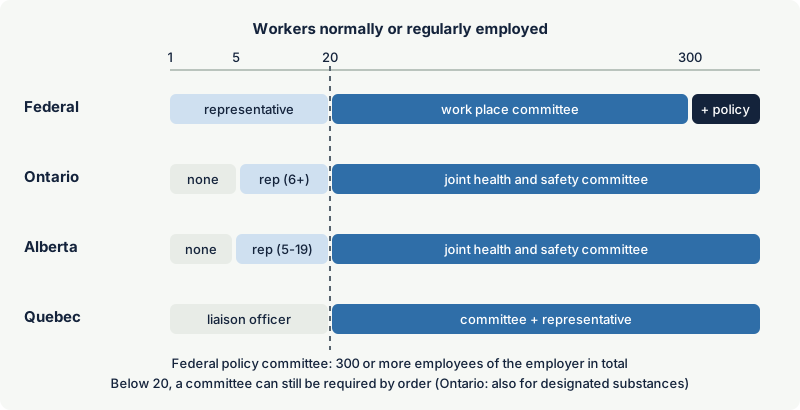
Yes. In almost every Canadian jurisdiction a joint health and safety committee is mandatory from 20 workers and smaller workplaces need a representative: federally below 20, in Ontario above 5 workers, in Alberta 5 to 19. Federal employers with 300 or more add a policy committee.
Yes. In almost every Canadian jurisdiction, a joint health and safety committee is mandatory at a workplace with 20 or more workers, and smaller workplaces must have a worker health and safety representative above a lower threshold. Under federal law, a work place committee is required from 20 employees, a representative below 20, and a separate policy committee for employers with 300 or more employees.
Short answer
- Federal (Canada Labour Code): work place health and safety committee at each work place with 20 or more employees (s. 135); health and safety representative where fewer than 20 (s. 136); policy health and safety committee for employers normally employing 300 or more directly (s. 134.1).
- Ontario: joint committee where 20 or more workers are regularly employed, where a designated substance regulation applies, or by order of the Minister; representative at workplaces with more than five workers that need no committee.
- Alberta: joint committee at 20 or more workers; representative at 5 to 19 workers, or where a Director designates.
- Quebec: establishments with 20 or more workers have a health and safety committee and a health and safety representative; those with 19 or fewer designate a liaison officer (agent de liaison). This has applied under an interim regime since 6 April 2022 and under a permanent regulation since 1 October 2025.
- Most other provinces and territories also use 20 workers (Saskatchewan uses 10), according to CCOHS. At least half of committee members represent workers.
How federal committees work
At least half of the members of a federal committee must be employees who do not exercise managerial functions, chosen by the employees or by their trade union. The committee must have at least two members. Its duties include taking part in the hazard prevention programme, the PPE programme and investigations, receiving and dealing with complaints, and monitoring accident and injury data.
| Rule | Federal requirement |
|---|---|
| Meetings | At least nine times a year at regular intervals, during working hours |
| Inspections | Each month, part of the work place, so that every part is inspected at least once a year |
| Employer response | In writing within 30 days to committee or representative recommendations |
| Information | Requested information to be provided within 30 days, or as soon as possible after |
| Training | Members and representatives receive the prescribed training |
| Posting | Names, telephone numbers and work locations of members posted |
| Policy committee | Meets at least quarterly; deals with matters across the employer's work places |
Committees must not see personal medical records without the person's consent. Members are paid at their regular or premium rate for their committee functions, even outside working hours, and the committee keeps minutes and records.
Provincial points to know
Ontario. Committees have at least two members at workplaces with fewer than 50 workers regularly employed and at least four at 50 or more (OHSA s. 9(6)); at least half are workers who do not exercise managerial functions, selected by the workers or their union. At least one worker member and one management member must be certified members, trained through programmes the employer carries out, with exceptions for construction projects with fewer than 50 workers or lasting less than three months. An employer must respond in writing within 21 days to written recommendations from a committee or a representative.
Alberta. Where two or more employers at one work site together regularly employ 20 or more workers, they must coordinate a joint committee for the site, unless a prime contractor has been designated; the same applies to a representative at 5 to 19 workers in total. Employers with 20 or more workers must also establish a health and safety programme.
Quebec. The law modernising the occupational health and safety regime (Loi modernisant le régime de santé et de sécurité du travail, 2021) introduced prevention and participation mechanisms for every establishment. An interim regime has applied since 6 April 2022, and the regulation on prevention and participation mechanisms in establishments took effect on 1 October 2025. Detailed rules, including committee composition, are in that regulation; check current requirements with the CNESST.
Example: A federally regulated trucking company normally employs 320 people directly: 60 at its head office, 140 and 112 at two terminals and 8 at a small depot. It needs a policy committee (300 or more employees), work place committees at the head office and at each terminal, and a health and safety representative at the depot. If the depot belonged to a business that is not federally regulated and was in Ontario, it would also need a representative, because more than five workers are regularly employed there.
Common mistakes
- Appointing worker members chosen by management: worker members are selected by the workers or their union.
- Treating the committee as a meeting only: federal committees must inspect every month and keep minutes.
- Missing the written response deadline to recommendations (30 days federally, 21 days in Ontario).
Related on excodex
- Occupational safety and health in Canada: law, authorities and employer duties
- What OSH training must employers provide to workers in Canada?
- Is a written risk assessment mandatory in Canada?
Standards and further reading
- Canada Labour Code, R.S.C. 1985, c. L-2, ss. 134.1 to 137: https://laws-lois.justice.gc.ca/eng/acts/L-2/
- Policy Committees, Work Place Committees and Health and Safety Representatives Regulations, SOR/2015-164: https://laws-lois.justice.gc.ca/eng/regulations/SOR-2015-164/
- Ontario Occupational Health and Safety Act, ss. 8 and 9: https://www.ontario.ca/laws/statute/90o01
- Alberta Occupational Health and Safety Act, ss. 13 to 16: https://kings-printer.alberta.ca/documents/Acts/O02P2.pdf
- CCOHS, Health and Safety Committees, table of requirements by jurisdiction (revised 30 August 2024): https://www.ccohs.ca/oshanswers/hsprograms/hscommittees/whatisa.html
- Government of Quebec news release (15 October 2024): https://www.quebec.ca/nouvelles/actualites/details/loi-modernisant-le-regime-de-sante-et-de-securite-du-travail-appliquer-le-regime-interimaire-des-maintenant-un-avantage-pour-tous-les-milieux-de-travail-58834
- Government of Quebec news release (1 October 2025): https://www.quebec.ca/nouvelles/actualites/details/loi-modernisant-le-regime-de-sante-et-de-securite-du-travail-un-nouveau-reglement-favorisant-la-prevention-des-le-1er-octobre-2025-66137
This article is general occupational safety and health information prepared by the excodex editorial team. It does not replace the applicable legislation, standards, manufacturers' instructions or the assessment of a competent OSH professional or occupational physician.
More questions on this topic
- What is the main occupational safety and health law in Canada and who enforces it?
- Must an employer in Canada appoint a safety professional or an occupational physician?
- Is a written risk assessment mandatory in Canada, and how often must it be reviewed?
- How and within what time must a workplace accident be reported in Canada?
- What OSH training must employers provide to workers in Canada?
- Are pre-employment and periodic medical examinations required for workers in Canada?
- What are the penalties for breaking occupational safety rules in Canada?
- How are explosive atmospheres and Ex equipment regulated in Canada?
Part of: Occupational safety and health in Canada: law, authorities and employer duties