Occupational safety International framework and country guides
Which rules apply to major-hazard chemical sites in Kyrgyzstan?
Part of: Occupational safety and health in Kyrgyzstan: law, authorities and employer duties
Short answer
Kyrgyzstan has no Seveso-type law with quantity tiers. Chemical and fuel sites are hazardous production facilities under Industrial Safety Law No. 160 of 2016 (amended 2023): registration, design expertise, production control, rescue plans, insurance, accident investigation.
Kyrgyzstan has no Seveso-type law with substance quantity thresholds and upper and lower tiers. Chemical, fuel and gas sites are regulated as hazardous production facilities under the Law "On industrial safety of hazardous production facilities" No. 160 of 2 August 2016, as amended on 10 January 2023, which requires identification and registration, a positive industrial safety expertise of the design, production control, emergency and rescue arrangements, liability insurance and technical investigation of every accident.
Short answer
- Main law: Law No. 160 of 2 August 2016 (О промышленной безопасности опасных производственных объектов), amended by Law No. 2 of 10 January 2023; it replaced the 2013 technical regulation on industrial safety.
- Which sites: any facility where flammable gases, oxidising, combustible or explosive substances, or highly potent toxic substances are produced, used, processed, stored, transported or destroyed, plus other criteria such as equipment under more than 0.05 MPa gauge pressure (Article 5).
- Not covered: electricity grid facilities, and low and medium pressure gas distribution and consumption networks supplying housing and non-production buildings.
- No quantity tiers in the law: risk categories and the registration and identification procedure are set by the Cabinet of Ministers (Article 5, part 4).
- Duties: identify and register the facility, obtain a positive expertise of the design documentation, run production control, inspect technical devices, keep rescue arrangements, reserves and warning systems, insure liability, and report and investigate accidents (Articles 9 to 13).
- Supervision: the Service of Environmental and Technical Supervision of the Ministry of Natural Resources, Ecology and Technical Supervision, within the rules on inspections of businesses (Article 14); it also imposes the fines under Articles 274 and 276 of the Code on Offences.
- Workers: the Law "On Labour Protection" No. 82 of 2026 applies in full alongside.
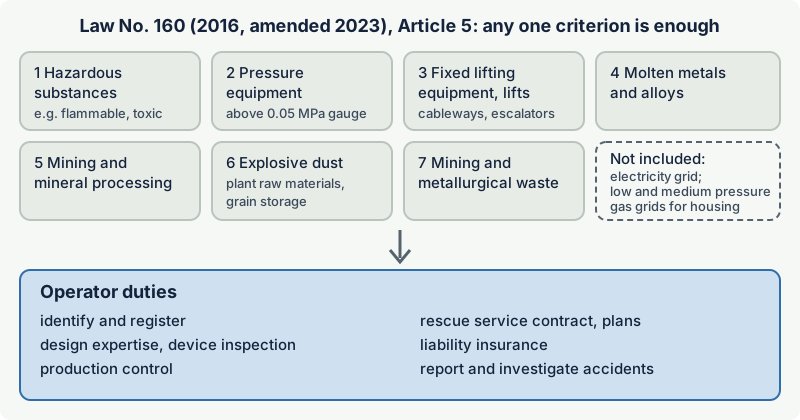
How the hazardous production facility regime works
The law defines hazardous substances by property rather than by name. Flammable gases, for example, are gases that form flammable mixtures with air at normal pressure and boil at 20 °C or below. Since the 2023 amendment the law no longer contains the numerical toxicity bands (LD50 and LC50 ranges) or the environmental hazard category of the 2016 text; it now covers "highly potent toxic substances" able to cause mass poisoning in an accident. Copies of the original 2016 text still circulate, so use the consolidated version.
Once a site is identified as a hazardous production facility, the operator must:
- have a positive industrial safety expertise of the design documentation before construction, operation, expansion, reconstruction, technical re-equipment, mothballing or decommissioning, and not deviate from the design;
- accept the facility into operation with testing of protective devices and a check that staff and rescue services are ready;
- hold the licences and permits required for its activity;
- admit only qualified, medically fit, trained and certified workers;
- run production control of industrial safety under the Cabinet's requirements;
- diagnose, test and inspect structures and technical devices at the intervals the Cabinet sets;
- contract professional emergency rescue services or create its own teams where civil protection law requires;
- keep financial and material reserves, monitoring, warning and communication systems and PPE for an accident;
- insure liability for harm caused by operating the facility, and report accidents, incidents and workplace injuries.
An accident (авария) is followed by a technical investigation by a special commission led by the industrial safety supervisory body, or by a state commission formed by the Cabinet, with the operator paying the costs (Article 12). Expertise may be done by the authorised body or by specialised organisations with certified experts (Article 13).
Comparison with Seveso III and Türkiye
| Element | Kyrgyzstan (Law No. 160) | EU Seveso III (Directive 2012/18/EU) | Türkiye (BEKRA Regulation, 2019) |
|---|---|---|---|
| Scope trigger | Type of substance or equipment | Named substances and categories above quantity thresholds | Seveso-aligned quantity thresholds |
| Tiers | Risk categories set by the Cabinet | Lower and upper tier | Lower and upper tier |
| Key document | Design expertise, production control, accident plans | Major accident prevention policy; safety report for upper tier | Major accident prevention policy document; safety report for upper tier |
| Public information and land use | Not found in Law No. 160 | Required | Public information required |
Example: An investor plans a 5,000 m3 diesel and LPG storage depot near Osh. Under EU rules the LPG quantity would be checked against Seveso thresholds. In Kyrgyzstan the depot is a hazardous production facility because it stores combustible and flammable substances and uses pressure vessels: the investor needs a positive expertise of the design, registration, a rescue service contract, liability insurance and a production control system, and must check which risk category the Cabinet's criteria assign to it. Pressure vessels must also meet TR CU 032/2013, and Ex equipment TR CU 012/2011.
Common mistakes
- Concluding that no special rules apply because Kyrgyzstan has no Seveso law.
- Starting construction before a positive expertise conclusion on the design.
- Working from the original 2016 text of Law No. 160 (as found on some international databases) instead of the 2023 consolidated version.
Related on excodex
- Occupational safety and health in Kyrgyzstan: law, authorities and employer duties
- Seveso III major accident prevention: tiers and duties
- How are explosive atmospheres and Ex equipment regulated in Kyrgyzstan?
- How and within what time must a workplace accident be reported in Kyrgyzstan?
Standards and further reading
- Law of the Kyrgyz Republic No. 160 "On industrial safety of hazardous production facilities", 2 August 2016, as amended 10 January 2023: official text.
- Regulation on the Service of Environmental and Technical Supervision, Cabinet of Ministers Resolution No. 338 of 24 December 2021 (as amended 8 December 2025): official text.
- EAEU technical regulations TR CU 032/2013 (pressure equipment) and TR CU 012/2011 (Ex equipment): Eurasian Economic Commission.
- Directive 2012/18/EU (Seveso III), for comparison.
- Türkiye: Regulation on the Prevention and Mitigation of Major Industrial Accidents (Büyük Endüstriyel Kazaların Önlenmesi ve Etkilerinin Azaltılması Hakkında Yönetmelik), 2 March 2019: mevzuat.gov.tr.
This article is general occupational safety and health information prepared by the excodex editorial team. It does not replace the applicable legislation, standards, manufacturers' instructions or the assessment of a competent OSH professional or occupational physician.
More questions on this topic
- What is the main occupational safety and health law in Kyrgyzstan and who enforces it?
- Must an employer in Kyrgyzstan appoint a safety professional or an occupational physician?
- Is a written risk assessment mandatory in Kyrgyzstan, and how often must it be reviewed?
- How and within what time must a workplace accident be reported in Kyrgyzstan?
- What OSH training must employers provide to workers in Kyrgyzstan?
- Are pre-employment and periodic medical examinations required for workers in Kyrgyzstan?
- What are the penalties for breaking occupational safety rules in Kyrgyzstan?
- Is a safety committee or a worker safety representative required in Kyrgyzstan?
Part of: Occupational safety and health in Kyrgyzstan: law, authorities and employer duties