Occupational safety International framework and country guides
Occupational safety and health in Kyrgyzstan: law, authorities and employer duties
Abstract
Kyrgyzstan's core OSH law is Law No. 82 "On Labour Protection" of 5 June 2026 (in force 19 June 2026), read with the 2025 Labour Code. The Ministry of Labour's inspection service enforces it; hazardous facilities also fall under the 2016 Industrial Safety Law and EAEU product rules.
Occupational safety and health in Kyrgyzstan is governed mainly by the Law of the Kyrgyz Republic No. 82 "On Labour Protection" of 5 June 2026, in force since 19 June 2026, together with Section V of the Labour Code of 2025. Compliance with labour and labour protection law is supervised by the Service for Control and Supervision of Labour Legislation under the Ministry of Labour, Social Security and Migration, while hazardous production facilities are also regulated by the Industrial Safety Law of 2016 and its technical supervision body. Products such as Ex equipment, PPE and machinery follow Eurasian Economic Union (EAEU) technical regulations and carry the EAC mark.
This guide maps the legal framework, the authorities, the main duties of employers and workers, and the points where an employer must still confirm details with the authority, because the 2026 law is new and its implementing regulations were still being aligned when this guide was written (November 2026).
Key points
- The Law "On Labour Protection" No. 82 of 5 June 2026 replaced the 2003 law (No. 167 of 1 August 2003) from 19 June 2026; it has 53 articles in 7 chapters.
- The Labour Code of the Kyrgyz Republic No. 23 of 23 January 2025 (in force 28 January 2025) contains a separate section on labour protection (Section V, Chapters 20 and 21, Articles 203 to 211) and, in Section VI, the rules on state control of labour law (Chapter 22).
- Organisations with more than 50 workers that carry out production activity must set up a labour protection service, whose specialists can stop unsafe work and remove workers who have not had their medical examination or safety instruction.
- Workers may refuse work that threatens their life or health without disciplinary consequences; PPE, special clothing and cleaning agents are provided at the employer's expense.
- The law defines the "assessment of occupational risks by working conditions (workplace attestation)" and the employer must organise it.
- Hazardous production facilities (flammable, toxic or explosive substances, pressure equipment above 0.05 MPa, lifting equipment, molten metal, mining, explosive dust) are regulated by Law No. 160 of 2 August 2016 with registration, industrial safety expertise, production control, liability insurance and a technical investigation of every plant accident (авария).
- As an EAEU member, Kyrgyzstan applies TR CU 012/2011 to Ex equipment and TR CU 019/2011 to PPE; an EAC certificate or declaration is needed, not an ATEX or IECEx certificate alone.
The legal framework: which laws apply
Kyrgyz labour protection law rests on the Constitution and consists of the Labour Code, the Law on Labour Protection, other normative legal acts and international treaties in force for Kyrgyzstan (Article 2 of Law No. 82). Russian is an official language next to Kyrgyz, so most practitioners work with the Russian text.
| Act (English) | Official name | Number and date | Role |
|---|---|---|---|
| Law on Labour Protection | Закон КР «Об охране труда» | No. 82, 5 June 2026, in force 19 June 2026 | Core OSH law: rights, employer and worker duties, service, commission, investigation, supervision, compensation, liability |
| Labour Code | Трудовой кодекс Кыргызской Республики | No. 23, 23 January 2025, in force 28 January 2025 (amended, latest 28 July 2026) | General labour law; Section V on labour protection; Chapter 22 on state control |
| Law on Industrial Safety of Hazardous Production Facilities | Закон КР «О промышленной безопасности опасных производственных объектов» | No. 160, 2 August 2016 | Hazardous facilities: registration, expertise, production control, accident investigation |
| Code on Offences | Кодекс КР о правонарушениях | No. 128, 28 October 2021 | Administrative sanctions, for example Article 87 on breaches of the labour protection law |
| Regulation on investigation and recording of workplace accidents | Положение о расследовании и учете несчастных случаев на производстве | Government Resolution No. 64, 27 February 2001 (amended) | Accident investigation procedure; to be aligned with Law No. 82 |
Law No. 82 was proposed by the Cabinet of Ministers, adopted by the Jogorku Kenesh (parliament) on 22 April 2026, signed on 5 June 2026 and published in the official newspaper "Erkin Too" on 9 June 2026. It took effect ten days after publication and repealed the 2003 law with all its amendments. The Cabinet of Ministers was given six months to bring its own regulations into line with the new law. Until that is done, check whether each government resolution adopted under the 2003 law (on the labour protection service, accident investigation, medical examinations and workplace attestation) is still in force and how it fits the new law.
Note: The official consolidated texts are published in the Centralised Legal Information Database of the Ministry of Justice (cbd.minjust.gov.kg). Check it, or ask the labour inspection, before relying on any subordinate regulation adopted before June 2026.
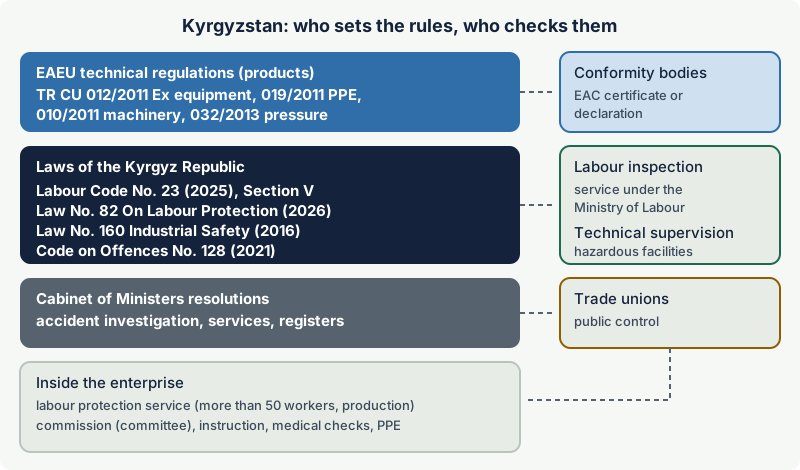
What Law No. 82 covers
The law applies to employers and workers, and also to members of cooperatives, students on production placements, people sent for training or rehabilitation, military personnel working in organisations, convicted persons working in organisations, and Kyrgyz citizens working at enterprises that are wholly or partly foreign-owned (Article 2). Its seven chapters cover general provisions and state policy (Articles 1 to 5); workers' rights and guarantees, including PPE, training, medical services and examinations, and limits on heavy and harmful work (Articles 6 to 15); the organisation of labour protection in the enterprise and accident investigation (Articles 16 to 21); state supervision and trade union control (Articles 22 to 24); employer liability and compensation for injury and occupational disease (Articles 25 to 48); liability for breaches, suspension and liquidation (Articles 49 to 52); and final provisions (Article 53).
Authorities: who enforces what
Labour and labour protection. The Service for Control and Supervision of Labour Legislation under the Ministry of Labour, Social Security and Migration (Служба по контролю и надзору трудового законодательства; Kyrgyz: Эмгек мыйзамдарын контролдоо жана көзөмөлдөө кызматы) works under a regulation approved by Cabinet of Ministers Resolution No. 317 of 17 December 2021 (last amended on 5 June 2026). It inspects employers, checks working conditions and safety requirements, and investigates workplace accidents. Law No. 82 gives state labour inspectors the right to enter organisations without hindrance, request documents, investigate accidents, issue binding orders, remove unprepared workers from work, and suspend organisations or equipment when workers' lives are threatened. Presidential Decree No. 362 of 26 October 2026 widened the Service's remit (adding migration control of foreign labour) and gave the Cabinet three months to restructure the ministry and its subordinate bodies, so check the current name and contact point before writing to it.
Industrial safety. Under Law No. 160 the Cabinet designates an authorised body for policy and permits and an authorised control body for supervision. The technical supervision function sits with the Service of Environmental and Technical Supervision under the Ministry of Natural Resources, Ecology and Technical Supervision (Cabinet Resolution No. 338 of 24 December 2021, last amended on 2 July 2026). Inspections follow the general legislation on inspections of business entities (Article 14 of Law No. 160).
Other bodies. Health authorities deal with sanitary rules and medical examinations; trade unions exercise public control through authorised (public) labour protection inspectors (Articles 23 and 24 of Law No. 82); for EAEU technical regulations, the Eurasian Economic Commission lists the Ministry of Economy and Commerce as Kyrgyzstan's ministry.
Employer and worker duties
Employer
Law No. 82 (Article 19) and the Labour Code (Article 204) place the main duty on the employer: to ensure safe working conditions and labour protection. Read together with the law as published, the practical duties are:
- Provide workplaces, equipment and materials that meet safety requirements (Article 8 covers production facilities and products).
- Organise the assessment of occupational risks by working conditions (workplace attestation) and act on the results.
- Train and instruct workers, test their knowledge, and not admit untrained workers (Article 10; Labour Code Article 206).
- Provide special clothing, footwear, PPE, soap and neutralising agents free of charge; provide milk or equivalent products in harmful work and therapeutic nutrition in especially harmful work (Articles 9 and 13).
- Arrange compulsory medical examinations for the categories of workers that need them (Article 14) and transport workers who fall ill at work to a medical facility (Article 15).
- Set up a labour protection service where required (Article 16); Article 17 also provides for a commission (committee) on labour protection, so check when it must be formed.
- Investigate and record accidents and occupational diseases (Article 21) and compensate harm caused by the employer's fault (Chapter 5).
Worker
Article 20 of Law No. 82 and Article 205 of the Labour Code set the worker's duties. In Kyrgyz practice these are to follow labour protection requirements, use personal and collective protective equipment correctly, attend training and knowledge tests, report at once to the manager any situation that threatens life or health, and attend compulsory medical examinations. Workers have the right to refuse work that threatens their life or health; refusal cannot lead to discipline or dismissal, and if the employer has not supplied the required PPE the worker cannot be made to work and the idle time must be paid.
OSH services, risk assessment, training and medical checks
Labour protection service. Organisations with more than 50 workers carrying out production activity must create a labour protection service (Article 16). The law defines production activity broadly: it includes production and processing, construction and the provision of services (Article 1). Its specialists can issue binding instructions, require the removal of workers who have not passed a medical examination or safety instruction, and stop equipment or work areas that endanger life. Smaller organisations still carry the full employer duty; in practice the employer or an assigned, trained person fills the role. The qualification required for service staff is set by subordinate regulation: confirm it with the inspection.
Occupational physician. No general duty to provide an occupational physician for every workplace (as Türkiye requires) could be verified in Law No. 82 or the Labour Code. Medical examinations are carried out by health organisations; Article 11 covers sanitary and medical services for workers.
Risk assessment. Kyrgyz law uses the post-Soviet concept of workplace attestation, which Law No. 82 now names "assessment of occupational risks by working conditions" (Article 1). It records and assesses all factors of the work environment and process at each workplace, drives improvement measures, and confirms or cancels compensations for harmful and heavy work. The interval for repeating it and the method are set by government regulation; they were not verified for the 2026 law and must be confirmed. An employer following ISO 45001 or EU practice should still keep a task-based risk assessment, because attestation focuses on measurable work-environment factors rather than every task hazard.
Training. Article 10 of Law No. 82 and Article 206 of the Labour Code require training, instruction (инструктаж) and knowledge testing; workers who have not passed them must not be admitted to work. Many employers use the post-Soviet types of instruction (induction, initial instruction at the workplace, repeat, unscheduled and targeted instruction) with knowledge testing for managers and specialists; which types are mandatory and how often must be checked in the current training regulation, as the frequencies were not verified for 2026.
Medical examinations. Article 14 of Law No. 82 makes medical examinations compulsory for certain categories of workers, and the employer must arrange regular medical checks; the Labour Code adds rules for workers under 18 and for women (Article 141). At hazardous production facilities only people without medical contraindications may be admitted to work (Law No. 160, Article 10). The categories, harmful factors and intervals are set by health regulations, which should be checked.
Accidents, investigation and supervision
Every workplace accident and occupational disease must be investigated and recorded (Article 21 of Law No. 82; Article 208 of the Labour Code). State labour inspectors have their own power to investigate accidents, and trade unions exercise public control over labour protection through their authorised inspectors. The detailed procedure is in the Regulation on investigation and recording of workplace accidents approved by Government Resolution No. 64 of 27 February 2001, which falls within the six-month alignment with Law No. 82. Its notification time limits, the composition of the investigation commission for serious, group and fatal accidents and the report forms could not be verified from an official text for this guide: employers must confirm them with the labour inspection.
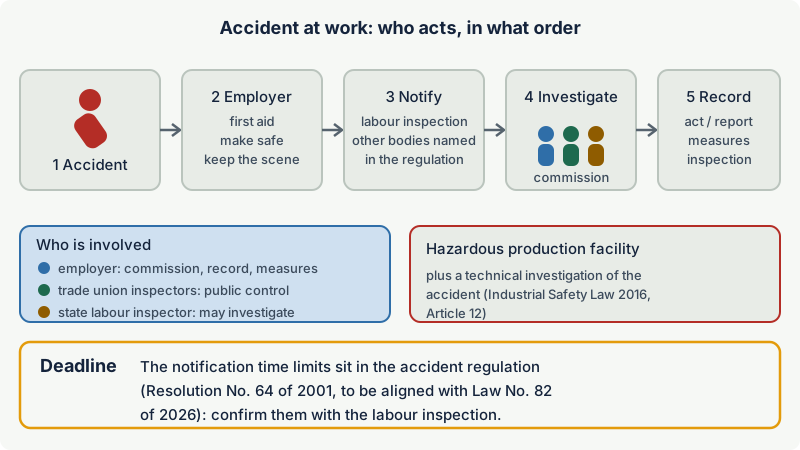
At a hazardous production facility, an accident (аварии, meaning destruction of plant, uncontrolled explosion, fire or release of hazardous substances) also triggers a technical investigation by a special commission led by the sector's authorised body, with the industry trade union among its members, or by a state commission (Article 12 of Law No. 160). Incidents are investigated by the operator's own commission. The operator must report accidents, incidents and workplace injuries to the authorised bodies (Article 10) and pays for the investigation.
Inspections follow the legislation on inspections of business entities. State inspectors can suspend work or equipment that threatens workers (Law No. 82, Articles 22 and 51), and Article 52 deals with the liquidation of an organisation or closure of a unit because of labour protection breaches.
Penalties. Administrative fines are set in the Code on Offences of 2021: Article 87 covers breaches of the labour protection law, Article 87-1 the employer's civil liability insurance, and Articles 274, 274-1 and 276 industrial safety breaches and unlicensed work at hazardous facilities. Fine amounts were not verified for 2026 and are not given here. The Code is amended often, and an amending law (No. 88 of 29 April 2025) takes effect on 1 January 2027, so read the current consolidated text. Criminal liability may also arise where a breach causes serious harm; confirm the applicable article with a Kyrgyz lawyer.
Chemicals, explosive atmospheres, major hazards and PPE
Chemicals and GHS. The EAEU technical regulation on the safety of chemical products (TR EAEU 041/2017), which brings in GHS-based classification and labelling, was not listed among the regulations in force on the Eurasian Economic Commission's page checked in November 2026. No national GHS regulation in force could be verified, so check the supplier's safety data sheet, the national sanitary rules on harmful substances and the EEC page for the regulation's start date.
Explosive atmospheres and Ex equipment. Ex equipment placed on the market must comply with TR CU 012/2011 "On the safety of equipment for work in explosive atmospheres", which entered into force in the Customs Union on 15 February 2013, and carry the EAC mark and the Ex marking. The standards listed for TR CU 012/2011 are interstate GOST standards largely based on the IEC 60079 series. No separate Kyrgyz workplace regulation equivalent to the EU ATEX workplace directive 1999/92/EC was found; explosion risk at work is managed through the industrial safety rules, fire safety rules and the employer's general duty.
Major hazards. Kyrgyzstan has no Seveso-type law with quantity thresholds and tiers. Instead, Law No. 160 lists categories of hazardous production facilities by type of substance and equipment, requires the operator to identify and register them, and imposes industrial safety expertise of designs and equipment, production control, emergency planning, contracts with professional rescue services, liability insurance and technical investigation of accidents.
PPE. PPE must comply with TR CU 019/2011 "On the safety of personal protective equipment" (in force from 1 June 2012) and carry the EAC mark; a CE mark alone is not enough for placing on the Kyrgyz market.
Comparison with the EU framework and Türkiye
| Topic | Kyrgyzstan | EU (Directive 89/391/EEC) | Türkiye (Law No. 6331) |
|---|---|---|---|
| Main act | Law No. 82 (2026) and Labour Code (2025) | Framework Directive plus national law | Law No. 6331 (2012) |
| Risk assessment | Workplace attestation (occupational risk assessment by working conditions) | Written risk assessment for all risks | Written risk assessment, renewed at least every 2, 4 or 6 years by hazard class |
| OSH service | Labour protection service above 50 workers in production | Competent workers or external services, no fixed headcount | OSH specialist and workplace physician for every employer (own staff or external service; the employer in some small firms) |
| Committee | Commission (committee) on labour protection, trade union inspectors | Consultation of workers and representatives | OSH committee at 50 or more workers and continuous work lasting over 6 months |
| Accident notification | Employer investigates and records; deadlines in Resolution No. 64 of 2001 (confirm) | List of accidents causing more than 3 working days' absence; reporting per national law | To the Social Security Institution (SGK) within 3 working days |
| Product marks | EAC (EAEU) | CE | CE (EU-aligned) |
Worked example: a contractor mobilising in Kyrgyzstan
A foreign engineering contractor will employ 70 local workers for 18 months to build and commission a fuel storage terminal near Bishkek. A practical start-up checklist under Kyrgyz law:
- Classify the site. Storage of flammable liquids and gases makes it a hazardous production facility under Law No. 160: the operator must identify and register it, obtain industrial safety expertise of the design, and arrange production control and liability insurance.
- Labour protection service. Construction counts as production activity under Law No. 82, so with 70 workers set up a labour protection service and appoint its head; agree its regulation with the client.
- Commission and unions. Plan the commission (committee) on labour protection with worker or trade union representatives (Article 17) and confirm when it becomes compulsory.
- Attestation and risk assessment. Plan the workplace attestation for the permanent workplaces and keep task risk assessments for construction activities.
- People. Arrange pre-employment medical examinations for harmful and dangerous work, induction and workplace instruction, and record knowledge tests.
- Equipment. Accept only Ex equipment and PPE with valid EAC certificates or declarations under TR CU 012/2011 and TR CU 019/2011.
- Accident plan. Write the notification chain (labour inspection, technical supervision body for facility accidents, and any other body the accident regulation names) and confirm the deadlines with the inspection.
Common mistakes
- Working from the 2003 law. Law No. 167 of 2003 lost force on 19 June 2026; cite Law No. 82 of 5 June 2026.
- Citing the 2004 Labour Code. The current Labour Code is No. 23 of 23 January 2025.
- Bringing ATEX or IECEx certificates only. Ex equipment needs EAC conformity under TR CU 012/2011.
- Assuming a Seveso regime. Major hazard control works through the hazardous production facility rules of Law No. 160, not quantity tiers.
- Copying deadlines from Kazakhstan or Russia. Accident notification limits differ by country; use the current Kyrgyz regulation.
- Treating attestation as a full risk assessment. It focuses on work-environment factors; task hazards still need their own assessment.
Frequently asked questions
What is the main OSH law in Kyrgyzstan?
The Law of the Kyrgyz Republic No. 82 "On Labour Protection" of 5 June 2026, in force since 19 June 2026, read together with Section V of the Labour Code of 2025. Hazardous facilities are also covered by the Industrial Safety Law No. 160 of 2016.
Who inspects workplaces for labour protection?
The Service for Control and Supervision of Labour Legislation under the Ministry of Labour, Social Security and Migration. Hazardous production facilities are supervised by the technical supervision body under the Ministry of Natural Resources, Ecology and Technical Supervision.
From how many workers is a labour protection service required?
From more than 50 workers in organisations carrying out production activity, under the 2026 law. Smaller employers keep the full duty and usually assign a trained person.
Do Kyrgyz workers have the right to refuse dangerous work?
Yes. A worker may refuse work that threatens life or health without discipline or dismissal, and cannot be required to work without the PPE the employer must provide.
Related on excodex
- What is the main occupational safety and health law in Kyrgyzstan and who enforces it?
- How and within what time must a workplace accident be reported in Kyrgyzstan?
- How are explosive atmospheres and Ex equipment regulated in Kyrgyzstan?
- Occupational safety and health in Kazakhstan
- CE, UKCA and EAC certification marks for work equipment and PPE
- Ex certification in other markets: UKEX, EAC, INMETRO, CCC, PESO
Standards and further reading
- Law of the Kyrgyz Republic No. 82 "On Labour Protection" (Об охране труда), 5 June 2026, published in "Erkin Too" No. 42 of 9 June 2026, in force 19 June 2026.
- Labour Code of the Kyrgyz Republic No. 23, 23 January 2025, in force 28 January 2025 (Section V, Chapters 20 and 21; Section VI, Chapter 22).
- Law of the Kyrgyz Republic No. 160 "On industrial safety of hazardous production facilities", 2 August 2016: original text on FAOLEX (later amendments not shown).
- Code of the Kyrgyz Republic on Offences No. 128, 28 October 2021 (Articles 87, 87-1, 274, 274-1, 276).
- Government Resolution No. 64 of 27 February 2001, Regulation on investigation and recording of workplace accidents (as amended).
- Cabinet of Ministers Resolution No. 317 of 17 December 2021 (labour inspection service) and No. 338 of 24 December 2021 (environmental and technical supervision service).
- Presidential Decree No. 362 of 26 October 2026 (wider remit of the labour inspection service, restructuring of the ministry).
- EAEU technical regulations TR CU 012/2011, TR CU 019/2011, TR CU 010/2011, TR CU 032/2013: Eurasian Economic Commission, regulations in force.
- Centralised Legal Information Database of the Ministry of Justice: cbd.minjust.gov.kg.
- Ministry of Labour, Social Security and Migration: mlsp.gov.kg.
This article is general occupational safety and health information prepared by the excodex editorial team. It does not replace the applicable legislation, standards, manufacturers' instructions or the assessment of a competent OSH professional or occupational physician.
Questions on this topic
- What is the main occupational safety and health law in Kyrgyzstan and who enforces it?
- Must an employer in Kyrgyzstan appoint a safety professional or an occupational physician?
- Is a written risk assessment mandatory in Kyrgyzstan, and how often must it be reviewed?
- How and within what time must a workplace accident be reported in Kyrgyzstan?
- What OSH training must employers provide to workers in Kyrgyzstan?
- Are pre-employment and periodic medical examinations required for workers in Kyrgyzstan?
- What are the penalties for breaking occupational safety rules in Kyrgyzstan?
- Is a safety committee or a worker safety representative required in Kyrgyzstan?
- How are explosive atmospheres and Ex equipment regulated in Kyrgyzstan?
- Which rules apply to major-hazard chemical sites in Kyrgyzstan?