Should a dust collector be located inside or outside a building?
Abstract
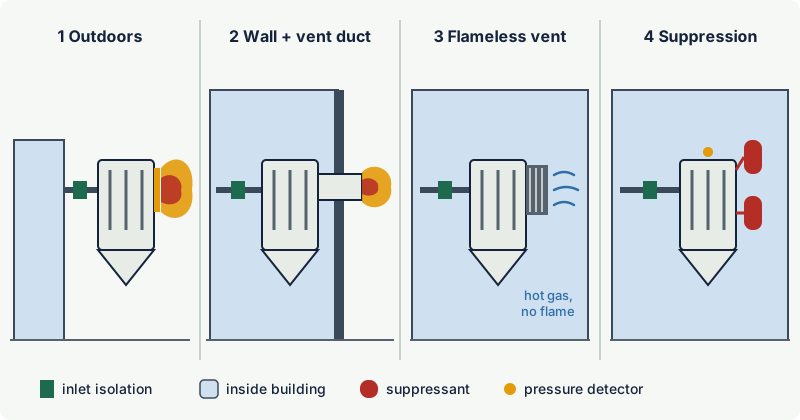
Outside, if the collected dust is explosible. Indoors is acceptable only when an explosion cannot reach the room: vents ducted outdoors from an outside wall, a certified flameless vent, suppression or containment, normally with isolation of the inlet duct.
Outside, whenever the dust it collects is explosible. A dust collector normally contains an explosive dust cloud, and an explosion vent turns an internal explosion into a fireball and a pressure wave that must go somewhere safe. Indoor siting is acceptable only when that energy cannot reach the room: vents ducted to the open air from a position against an outside wall, a certified flameless venting device, explosion suppression or a pressure-resistant design, in practice combined with isolation of the inlet duct so the explosion cannot travel back to the pickup points.
Short answer
- Default: site collectors for explosible dust outdoors, with the vents pointing away from buildings, walkways and roads. UK guidance from the Health and Safety Executive (HSE) strongly recommends open-air siting for large plant, for filters that contain a dust cloud in normal operation and wherever a particularly severe explosion is possible.
- Indoors, acceptable options: next to an outside wall with a short, straight vent duct to the open air; a flameless venting device certified for the dust; explosion suppression; or containment (equipment built to withstand the explosion pressure).
- Not acceptable: an open vent panel discharging into the room. HSE guidance notes that vents discharging inside a building give the people in it little protection.
- Wherever it stands, the collector normally needs isolation on the inlet duct (unless an assessment shows an explosion cannot travel back), protection of any clean-air duct returning to a workroom, and interlocks that stop the fan and feed.
- If testing shows the collected dust is not explosible, the explosion argument for outdoor siting falls away, but fire and health risks still need assessment.
Why outdoors is the default
A filter is designed to concentrate the finest fraction of the dust in the plant, and the inside of the dirty side is normally a Zone 20. Ignition sources also arrive from outside: sparks and embers from grinding, sanding or dryers travel down the ducts. So an explosion inside a collector is a credible event, not a remote one.
Venting does not make that explosion disappear; it moves it outside the vessel. HSE guidance warns that the fireball from a vent is usually much larger than the vessel it came from and can spread burning particles a substantial distance. Indoors, the same fireball and pressure wave also lift settled dust from beams and floors and can ignite a much larger secondary explosion in the building. Outdoors, the vent discharges into open air, and the remaining task on the vent side is to keep people and other plant out of the discharge zone.
What codes and guidance say
| Source | What it expects |
|---|---|
| HSE guidance HSG103 (UK) | Open-air siting strongly recommended for large plant, for filters with a dust cloud inside in normal operation and where severe explosions are possible; otherwise locate plant close to an outside wall and lead vent discharges outdoors through straight ducts of minimum length, with at least the vent cross-section. Flameless venting devices are mentioned as an alternative. |
| OSHA 29 CFR 1910.272 (US grain handling) | Filter collectors installed after 30 March 1988 must be outside, or inside protected by explosion suppression, or inside in an area separated by construction with at least a one-hour fire-resistance rating, next to an exterior wall and vented outside, with vent and ductwork designed to resist rupture. |
| NFPA dust standards (US) | As quoted by OSHA in 1997, NFPA 664 (wood) required dust collectors to be outside buildings, with indoor exceptions for collectors against an exterior wall venting outdoors through short, straight ducts or protected by explosion suppression to NFPA 69. NFPA 664 and the other dust standards are now consolidated into NFPA 660; check its current wording. |
The European ATEX framework does not prescribe a location. Under Directive 1999/92/EC the employer's risk assessment decides, and vent panels, flameless vents, suppression systems and isolation devices are protective systems that must carry their own certification under Directive 2014/34/EU and be used within its limits.
How the indoor options compare
| Arrangement | What leaves the collector in an explosion | Conditions |
|---|---|---|
| Vent ducted outdoors | Flame and pressure, released outside | Collector against an outside wall; duct straight and short; vent and duct both larger than a free vent; discharge zone outside kept clear |
| Flameless vent | Hot gas and a pressure wave near the device, no flame | Certified (for example to EN 16009) for the dust, its Kst and Pmax and the vessel volume; clear space around the device; not for dusts the certificate excludes, such as many metal dusts |
| Suppression | Nothing, if it works | Designed for the vessel and the dust (EN 14373, NFPA 69); detectors and suppressant containers serviced regularly |
| Containment | Nothing; the vessel holds the pressure | Vessel, ducts and valves rated for the maximum explosion pressure (EN 14460); expensive for large collectors |
Kst and Pmax are the explosion severity values of the dust; see Dust explosion parameters explained. In all four cases the explosion can still run back through the inlet duct to every pickup point unless an isolation device stops it.
Example: A joinery wants to keep a new cartridge collector in the workshop to save duct length. The wood dust is St 1. Option one is to move it to the outside wall and duct the vent through the wall; option two is a flameless vent certified for wood dust of that Kst and volume, with an area around it kept free of people during operation. Either way a flap valve or active barrier goes in the inlet duct, and the return of cleaned air to the workshop is assessed for both explosion and health exposure.
Common mistakes
- Treating a roof-mounted or outdoor collector as finished. An outdoor collector still sends the explosion back into the building through the inlet duct if there is no isolation.
- Fitting a standard vent panel indoors "because it is certified". The certificate covers the panel, not the place it discharges into.
- Returning cleaned air to the workroom without assessment. A torn bag sends dust, and in an explosion flame, straight back into the room.
- Long or bent vent ducts. Every duct restricts flow; length and bends raise the pressure in the collector and must be in the vent design.
Related on excodex
- Dust collectors, silos and bucket elevators: where dust explosions start
- Dust explosion protection: venting, suppression, isolation and containment
- Can an explosion vent discharge inside a building?
- When is an explosion vent required on a dust collector?
- Why does a vented dust collector still need isolation on the inlet duct?
Standards and further reading
- EN 14491, dust explosion venting protective systems; EN 16009, flameless explosion venting devices; EN 14373, explosion suppression systems; EN 15089, explosion isolation systems; EN 14460, explosion resistant equipment.
- NFPA 660, standard for combustible dusts and particulate solids (consolidates NFPA 61, 484, 652, 654, 655 and 664); NFPA 68 (venting) and NFPA 69 (prevention systems, including suppression and isolation).
- HSE, HSG103 Safe handling of combustible dusts: hse.gov.uk (PDF)
- OSHA, 29 CFR 1910.272 Grain handling facilities, paragraph on filter collectors: osha.gov
- OSHA, Hazard information bulletin, improper installation of wood dust collectors (2 May 1997, citing NFPA 664): osha.gov
This article is general technical information prepared by the excodex editorial team. It does not replace the applicable standards, the equipment certificates and instructions, national regulations or the assessment of a competent person.